

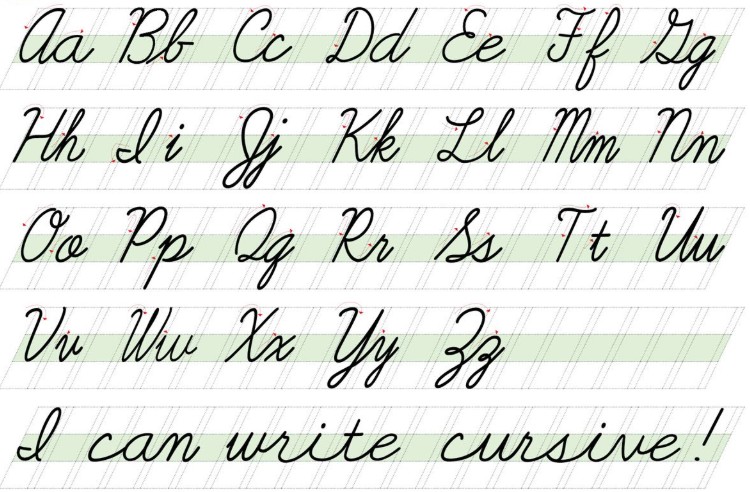
When I was in second grade, my teacher handed me a sheet of paper lined with faint blue curves. “Let your letters dance”, she said, as we practiced cursive loops and twirls. At the time, it felt like learning a secret code – one that connected me to generations before me. Today, in a world of screens and keyboards, cursive writing might seem quaint, but research shows it is anything but ready to become obsolete. Studies published in Frontiers of Psychology confirm that learning cursive stimulates brain synapses and synchronizes both hemispheres of the brain, enhancing reading
and spelling abilities (James & Engelhardt, 2012). The continuous, flowing motion of cursive writing activates regions linked to thinking, language and working memory, supporting deeper learning and mental agility (Berninger et al, 2014).
It was seen that students who struggled with reading and learning showed remarkable improvements in their literacy skills once they were introduced to, and started practising cursive writing. Mueller and Openheimer found that students taking notes by hand, especially in cursive, retained information more effectively than those who typed. The act of joining letters encourages deeper cognitive processing, leading to improved memory. Cursive also supports the development of executive function skills, such as planning
and organization, as students learn to anticipate the flow of words and sentences. It improves writing speed and efficiency, making it easier to keep pace during note-taking or timed assessments.
The rhythmic, connected movements of cursive can be therapeutic, helping to reduce stress and promote mindfulness. For children with learning differences like dyslexia, cursive helps reinforce letter formation and reduce letter reversals. Writing in cursive nurtures creativity and individuality, allowing children to develop a personal style and express themselves in ways that print
writing’s uniformity cannot match (Sassoon, 2009).
In summary, cursive writing enriches cognitive development, motor coordination, memory retention, creativity, pattern recognition, visual-spatial awareness, mindfulness, executive function, writing speed and linguistic versatility. Despite the rise of digital technology, cursive writing remains a vital tool for cognitive growth and
academic success.
Thus, integrating cursive in education maximises students’ potential, equipping them with the skills that go far beyond mere writing.
Preeti is an M.Sc. in Developmental Biology and has dual B.Eds in Science and Special Education (Learning Disabilities). She is a dedicated RCI-registered Special Educator and the founder of her own remediation centre, NurtureNest. A licensed Brain Gym Instructor, she integrates Brain Gym, Movement-Based Learning, and Reflex Management into her practice to create dynamic and effective learning experiences for her students.