
When we think of relaxation, we often focus on the body. We lie down on a couch, stretch out comfortably, or scroll through social media. But a relaxed body does not necessarily mean relaxed eyes.
Our eyes are constantly working. Even while watching Instagram Reels or television, they are actively focusing, tracking movement, processing light, and interpreting information. True visual relaxation is something many of us rarely experience.
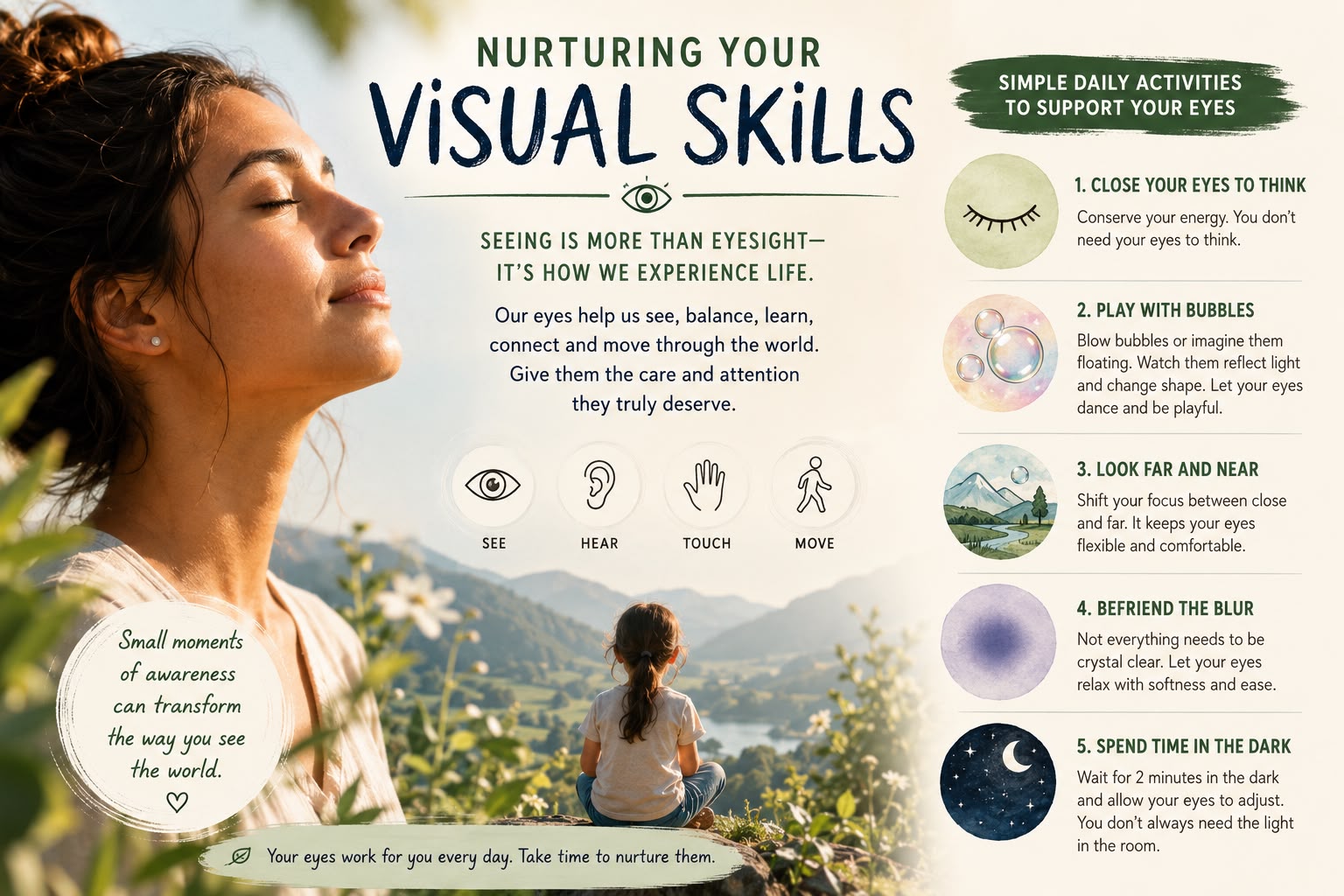
The way we relate to the world through our eyes, ears, touch, and movement creates the sensory background that colours our entire experience of life. These sensory experiences influence how we feel, learn, respond, and connect with the world around us.
Learning to see is a developmental process, just like learning to walk, read, or ride a bicycle. Vision is not simply something that happens automatically because our eyes are open. It develops through our interaction with the environment.
A young child sees with beginner’s eyes. They perceive the whole picture and its details simultaneously, approaching the world with curiosity, wonder, and openness. As we grow older, our visual habits become more fixed and often more demanding.
Interestingly, when we visit a medical doctor, we expect our health to improve. Yet when many people visit an ophthalmologist, they often expect their prescription numbers to increase over time. We tend to accept declining visual comfort as inevitable, rather than considering how we can actively support and nurture our visual system.
Vision is about far more than understanding what we see. Our visual system plays a major role in balance, movement, coordination, and orientation in space. In fact, we rely on our visual sense more than any other sense to navigate our daily lives.
Perhaps it’s time to give our eyes the care and attention they deserve.
Simple Daily Activities to Support Your Visual Skills
1. Close Your Eyes to Think
We often keep our eyes open even when visual information isn’t necessary. Try closing your eyes while reflecting, planning, or remembering. This reduces visual input and conserves energy, allowing your brain to focus on the task at hand.
2. Play with Bubbles
Blow bubbles or simply imagine them floating through the air. Notice how they reflect light, change shape, drift, and move. As you watch or imagine them, allow your eyes to move freely and playfully, adapting and changing just as the bubbles do.
3. Look Far and Near
Spend a few moments alternating your focus between something close and something far away. This gentle activity helps maintain flexibility in the visual system and encourages comfortable focusing.
4. Become Friends with Blur
We often rush to sharpen everything we see. Instead, allow yourself moments of comfortable blur. Relax and notice that not every visual experience needs to be clear all the time.
5. Spend Time in the Dark
When entering a dim room, resist the urge to immediately turn on a light. Wait for a couple of minutes and allow your eyes to adjust naturally. Your visual system is designed to adapt to changing light conditions.
A New Habit of Attention
Our eyes work tirelessly every day. Just as we nurture our physical fitness, emotional well-being, and mental health, we can also nurture our visual skills.
Small moments of visual awareness and relaxation can help us reconnect with the natural flexibility and adaptability of our visual system. By giving our eyes regular opportunities to rest, move, adjust, and explore, we support not only our vision but also our overall sense of well-being.
After all, seeing is not simply about eyesight—it is about how we experience life itself.
Inspired by the Brain Gym®️ Vision Circles Handbook.
Minaz Ajani -M. Ed (Sp. Ed) LD., is an accomplished Educator and International Faculty member of Breakthroughs International, Home of the Brain Gym® program. She is a licensed Brain Gym®, Touch for Health®, RMTi and Movement-Based Learning instructor and consultant.