
Have you ever noticed how some people can quickly adjust when plans change, while others feel stuck or overwhelmed?
A growing body of research suggests that this ability—known as cognitive flexibility—is one of the brain’s most important skills. Cognitive flexibility is our ability to shift attention, adapt to new situations, learn from experience, and try a different approach when the old one is no longer working.
What the Research Says
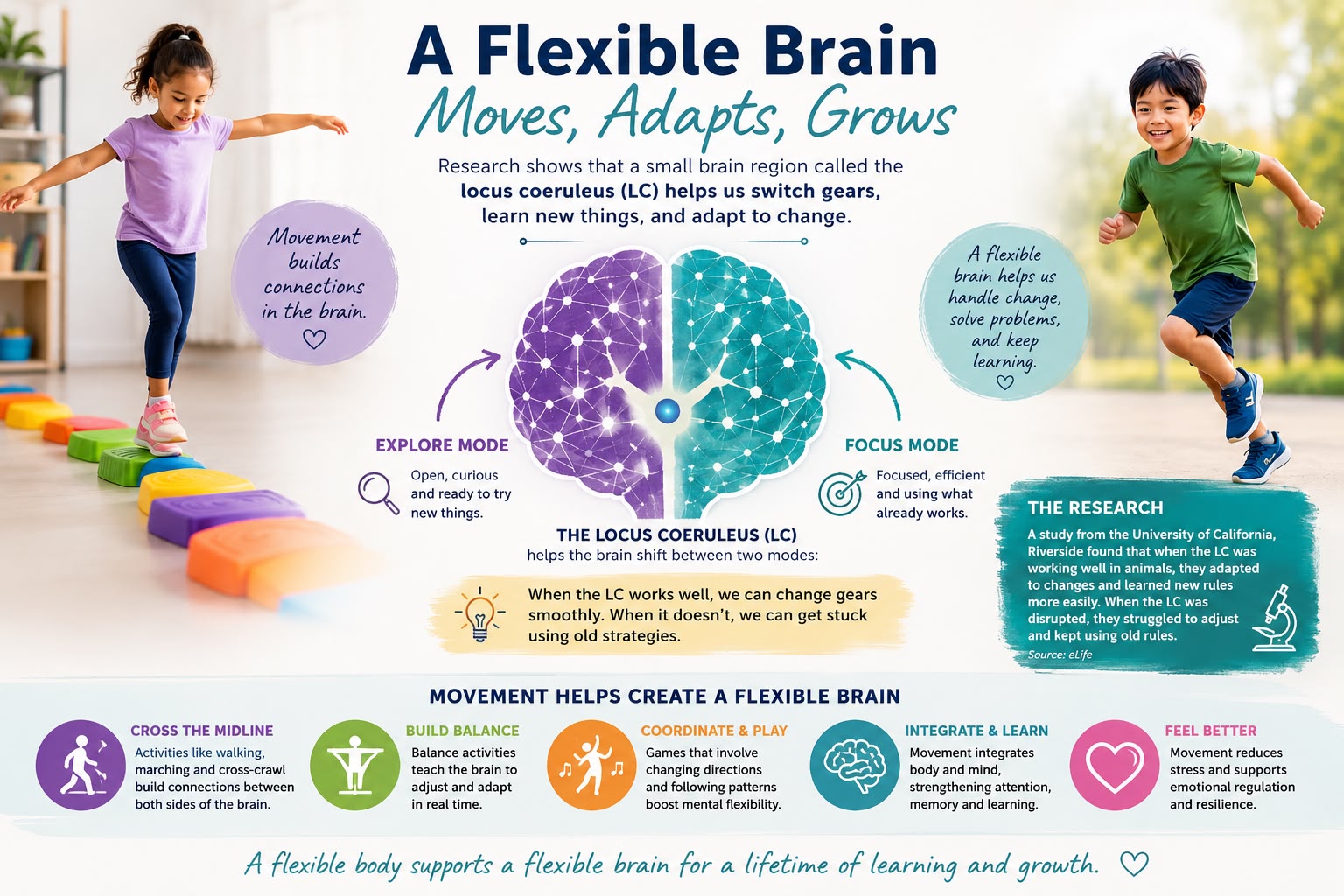
A recent study by researchers at the University of California, Riverside, published in the journal eLife, identified a small but powerful brain region, the locus coeruleus (LC), as critical for cognitive flexibility.
The researchers found that the LC helps the brain “change gears” when circumstances change. In animal studies, when this region was functioning well, subjects were able to let go of old rules and learn new ones more efficiently. When the LC was disrupted, they struggled to adapt and continued using outdated strategies.
The study suggests that the brain is not designed to remain in a single mode of thinking. Instead, it constantly shifts between:
* Focused mode – concentrating on what is already known.
* Exploratory mode – being open to new information and possibilities.
A healthy, flexible brain can move smoothly between these modes as needed.
Why Cognitive Flexibility Matters
Cognitive flexibility affects almost every aspect of life:
* Learning new skills
* Problem-solving
* Managing change
* Emotional regulation
* Social relationships
* Academic success
* Healthy ageing
Children with challenges in cognitive flexibility may struggle with transitions, become upset when routines change, or persist with a strategy that isn’t working. Adults may experience rigidity in thinking, difficulty coping with unexpected events, or resistance to new ideas.
In many ways, cognitive flexibility is what allows us to keep growing throughout life.
Movement: The Missing Piece
While we often think of flexibility as a mental skill, it is deeply connected to the body.
The brain develops through movement.
Every time we move, balance, reach, crawl, walk, turn, or coordinate both sides of the body, we are providing the brain with rich sensory information. These movement experiences help create new neural connections and strengthen communication between different brain regions.
Movement teaches the brain to:
* Adapt to changing environments
* Shift attention
* Coordinate multiple systems simultaneously
* Respond to new challenges
In other words, movement is practice for flexibility.
How Movement Supports a Flexible Brain
1. Cross-Lateral Movements
Activities that cross the midline of the body help strengthen communication between the left and right hemispheres of the brain.
Examples:
* Walking
* Marching
* Cross-crawl activities
* Dancing
* Tai-chi
1. Balance Activities
Balance challenges require constant adjustment and adaptation.
Examples:
* Standing on one foot
* Walking on uneven surfaces
* Using balance boards
1. Coordinated Movement Games
Games that involve changing directions, following patterns, or responding to cues encourage mental flexibility alongside physical flexibility.
1. Brain Gym® and Movement-Based Learning
2. RMTI
Movement programs such as Brain Gym® are based on the understanding that movement prepares the brain for learning by integrating sensory, motor, and cognitive processes. Purposeful movement can help individuals become more adaptable, attentive, and ready to learn.
For Children and Adults Alike
A flexible brain is not built by sitting still and thinking harder. It develops through experience, exploration, and movement.
Whether it is a child learning to adapt to classroom changes, an adult navigating life’s challenges, or a senior maintaining cognitive health, movement provides the brain with opportunities to practice flexibility every day.
Final Thoughts
The research on the locus coeruleus reminds us that the brain is designed to adapt. Our ability to switch strategies, learn from new experiences, and respond to change is supported by specific neural networks that thrive on challenge and novelty.
By incorporating movement into daily life, we give the brain exactly what it needs to strengthen these networks.
A flexible body supports a flexible brain, and a flexible brain helps us navigate an ever-changing world with greater ease, confidence, and resilience.
Minaz Ajani -M. Ed (Sp. Ed) LD., is an accomplished Educator and International Faculty member of Breakthroughs International, Home of the Brain Gym® program. She is a licensed Brain Gym®, Touch for Health®, RMTi and Movement-Based Learning instructor and consultant.