
“Movement is not simply something we do—it is how the brain learns, grows, and connects with the world.”
Have you ever reached for your cup of tea without looking at it? Walked through your home in the dark without bumping into furniture? Or climbed stairs while talking to someone?
You probably didn’t think about every movement. Your body simply knew what to do.
This remarkable ability is called kinesthesia—often referred to as the body’s visceral intelligence.
What is Kinesthesia?
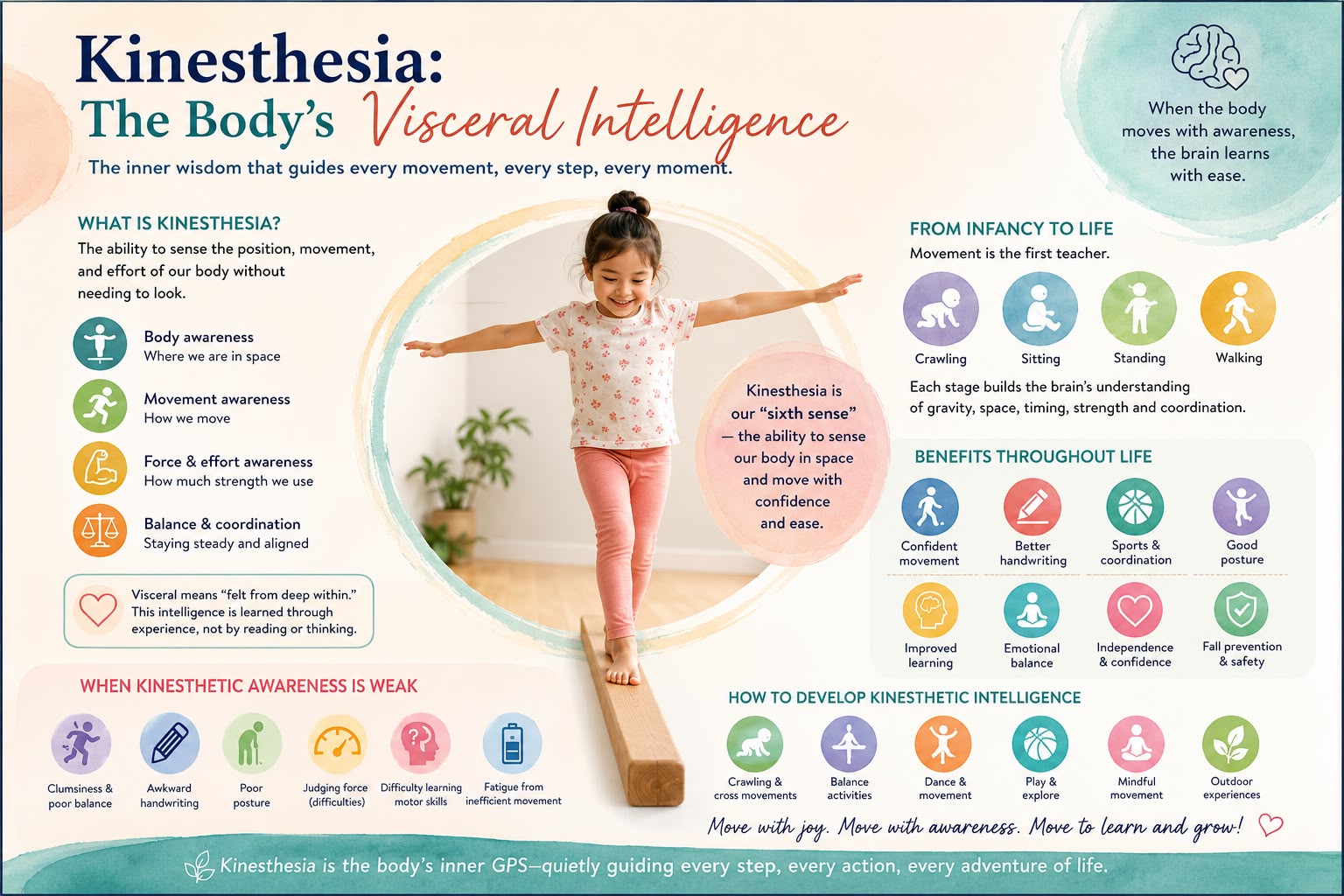
Kinesthesia is our ability to sense the position and movement of our body without relying on our eyes. It is sometimes called our “sixth sense.”
Tiny receptors in our muscles, tendons, joints, skin, and inner ear constantly send information to the brain about:
* Where our body is in space
* How our limbs are moving
* How much force we are using
* Whether we are balanced
* How fast or slowly we are moving
Our brain processes this information automatically, allowing movement to become smooth, efficient, and effortless.
Why is it called “Visceral Intelligence”?
The word visceral means coming from deep within.
Unlike facts that we memorize, visceral intelligence cannot be taught through words alone. It develops through experience, movement, exploration, and interaction with the environment.
Our body learns by doing.
Each time we move, our nervous system collects information, refines it, and becomes more efficient. Over time, movement becomes automatic, requiring less conscious effort.
The Beginning of Learning
A baby’s education begins long before speaking or reading.
Through simple movements such as:
* Reaching
* Rolling
* Crawling
* Sitting
* Standing
* Walking
the brain learns about gravity, balance, space, timing, strength, and coordination.
These early movement experiences build the neurological foundations for attention, learning, language, emotional regulation, and problem-solving.
Movement truly becomes the first teacher.
Kinesthesia Throughout Life
Kinesthetic intelligence continues to support us every day.
It helps us:
* Walk confidently without watching our feet.
* Write smoothly.
* Ride a bicycle.
* Play sports.
* Dance.
* Play a musical instrument.
* Maintain good posture.
* Prevent falls.
* Learn new motor skills.
Even something as simple as buttoning a shirt or pouring a cup of tea depends on accurate kinesthetic awareness.
When Kinesthetic Awareness is Weak
When the brain doesn’t receive or process movement information efficiently, everyday tasks may become more difficult.
People may experience:
* Poor balance
* Clumsiness
* Awkward handwriting
* Difficulty with sports
* Poor posture
* Using too much or too little force
* Fatigue from inefficient movement
* Difficulty learning new physical skills
For children, these challenges can affect classroom performance. For older adults, reduced kinesthetic awareness may increase the risk of falls and loss of confidence in movement.
Movement Changes the Brain
Modern neuroscience confirms that movement is one of the brain’s most powerful learning tools.
Every purposeful movement strengthens communication between the brain and the body, creating more efficient neural pathways. As movement becomes more organized, thinking, attention, and emotional regulation often improve as well.
This is why movement-based approaches such as Brain Gym®, Rhythmic Movement Training (RMTi), and other sensorimotor programs place such importance on simple, intentional movement experiences.
Developing Your Kinesthetic Intelligence
The good news is that kinesthetic awareness can be improved at any age.
Activities that nurture this intelligence include:
* Crawling and cross-lateral movements
* Balance activities
* Dance
* Yoga
* Tai Chi
* Brain Gym® movements
* Playing with balls
* Climbing and exploring
* Walking on different surfaces
* Mindful movement and breathing exercises
The more varied and meaningful the movement experiences, the richer the brain’s understanding of the body.
Final Thoughts
We often think of intelligence as something measured by tests or expressed through words. But one of our earliest and most important forms of intelligence is the wisdom carried within the body.
Kinesthesia is the body’s inner GPS. It quietly guides every step, every reach, every adjustment, and every graceful movement we make. It develops from infancy, supports learning throughout life, and reminds us that sometimes the deepest understanding doesn’t come from thinking—it comes from moving.
⸻
Reflection
“Before we learned through words, we learned through movement. By reconnecting with our body’s visceral intelligence, we awaken the foundation for learning, confidence, and lifelong well-being.”
Inspired by concepts from the Brain Gym® Vision Circles Handbook and contemporary neuroscience on movement and learning.