
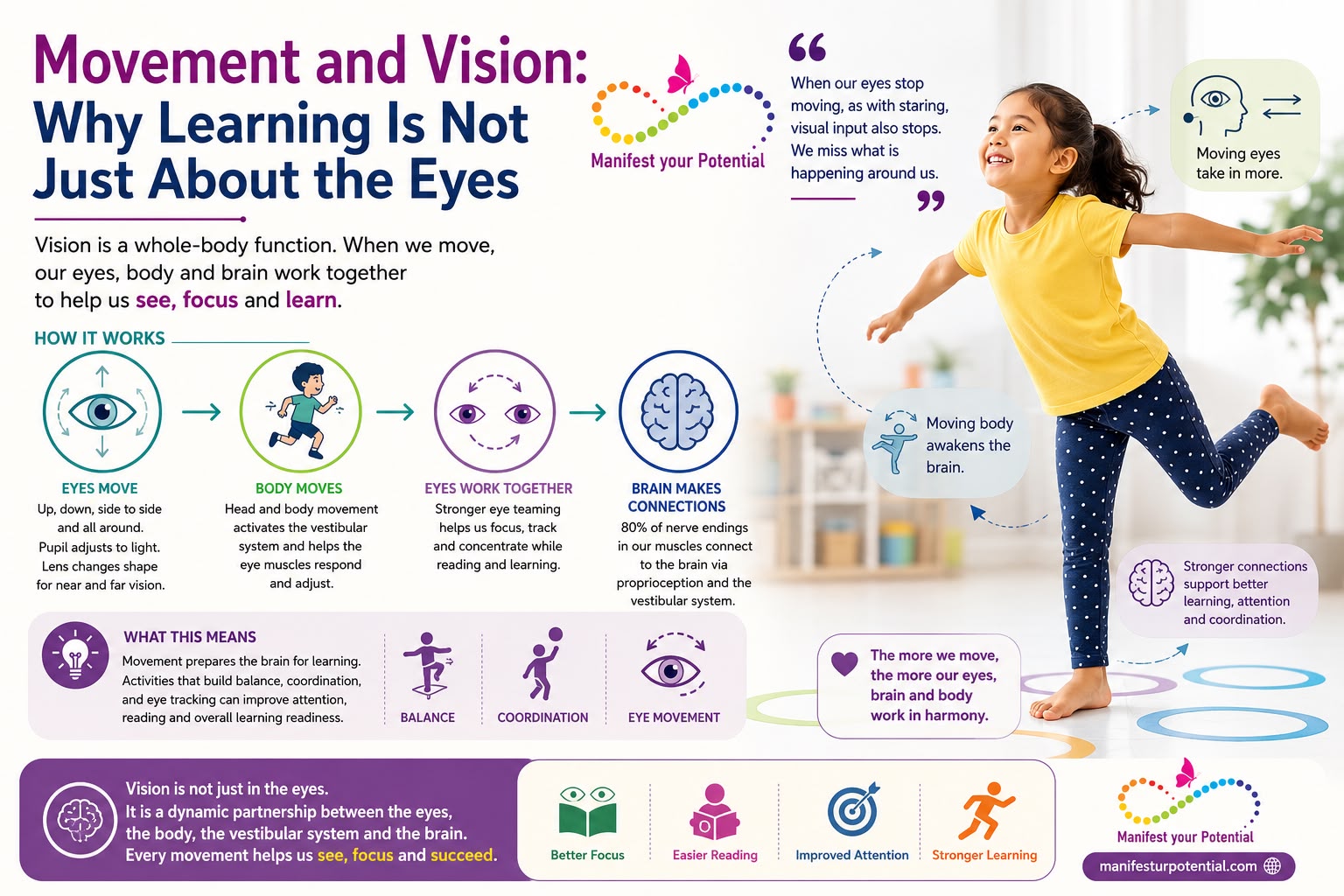
When we think about vision, we often imagine that it begins and ends with our eyes. But in reality, vision is a whole-body process. The way we move our body has a powerful influence on how well we see, focus, and learn.
Your Eyes Are Always Meant to Move
In an active learning situation, your eyes are constantly moving.
They move:
* Up and down while reading.
* Side to side when scanning a page.
* Around the environment when searching for information.
At the same time, tiny muscles inside the eyes are hard at work:
* The pupil adjusts to let in the right amount of light.
* The ciliary muscles change the shape of the lens so we can shift our focus between near and far objects.
Vision is an active process—not a passive one.
What Happens When We Stare?
Have you ever been so focused on one spot that you failed to notice what was happening around you?
When our eyes become fixed in a stare, visual input actually decreases. We stop gathering new information from our surroundings. Our awareness narrows, and we may miss important details in the environment.
Healthy vision depends on movement.
Why Body Movement Matters
Every time we move our head or body, we activate the vestibular system—the part of the inner ear responsible for balance and spatial orientation.
As the vestibular system is stimulated:
* The eye muscles automatically adjust to keep our vision stable.
* Both eyes learn to work together more efficiently.
* Eye movements become smoother and more coordinated.
This teamwork between the eyes is essential for reading, writing, copying from the board, catching a ball, and many other everyday tasks.
Eye Teaming Supports Learning
When both eyes work together efficiently, children and adults are better able to:
* Focus on a task.
* Track words across a page.
* Shift attention between near and far objects.
* Maintain concentration while reading.
* Process visual information with less effort.
These skills form the foundation for successful learning.
The Brain Loves Movement
One fascinating fact is that approximately 80% of the nerve endings in our muscles provide sensory information back to the brain. Through the body’s proprioceptive (body awareness) and vestibular (balance and movement) systems, this information helps coordinate movement—including the movements of the eyes.
As we move, we continually strengthen the communication between the body, eyes, and brain. The richer these connections become, the more efficiently we can process visual information and respond to our environment.
What This Means for Parents, Teachers and Therapists
If a child struggles with reading, attention, or visual tracking, the answer may not lie in asking them to “try harder” or simply spend more time looking at the page.
Instead, it may help to first prepare the brain and body through movement.
Activities that encourage balance, coordination, cross-body movement, and eye tracking can support the visual system and improve readiness for learning.
Sometimes, the best way to improve vision is not to look harder—but to move more.
Final Thought
Vision is not just something that happens in the eyes. It is a dynamic partnership between the eyes, the body, the vestibular system, and the brain.
Every movement we make helps build stronger connections that support attention, reading, coordination, and learning.
So the next time you see a child moving before settling down to learn, remember—they may actually be preparing their brain to see, focus, and succeed.
Inspired by concepts from Smart Moves: Why Learning Is Not All in Your Head by Carla Hannaford.
Minaz Ajani has a Master’s in Sp. Ed with a focus on Learning Disabilities. She is an Internationally Licensed Brain Gym®️ , Touch for Health®️ , Movement-Based Learning™️ and RMTI ®️ Instructor and consultant and founder of Manifest Your Potential (http://manifesturpotential.com)