

Most people think vision depends only on the eyes. In reality, vision is a whole-body process. The way we stand, walk, and move affects how efficiently our brain receives and processes visual information.
One of the most overlooked influences on vision is the way the feet function during walking.
The Feet: Your Foundation for Vision
Every step you take sends information from the feet to the brain about balance, body position, and movement. This sensory information helps the brain stabilize the head and eyes so you can see clearly while moving.
When the feet move efficiently, the eyes can remain stable, track smoothly, and shift focus with less effort.
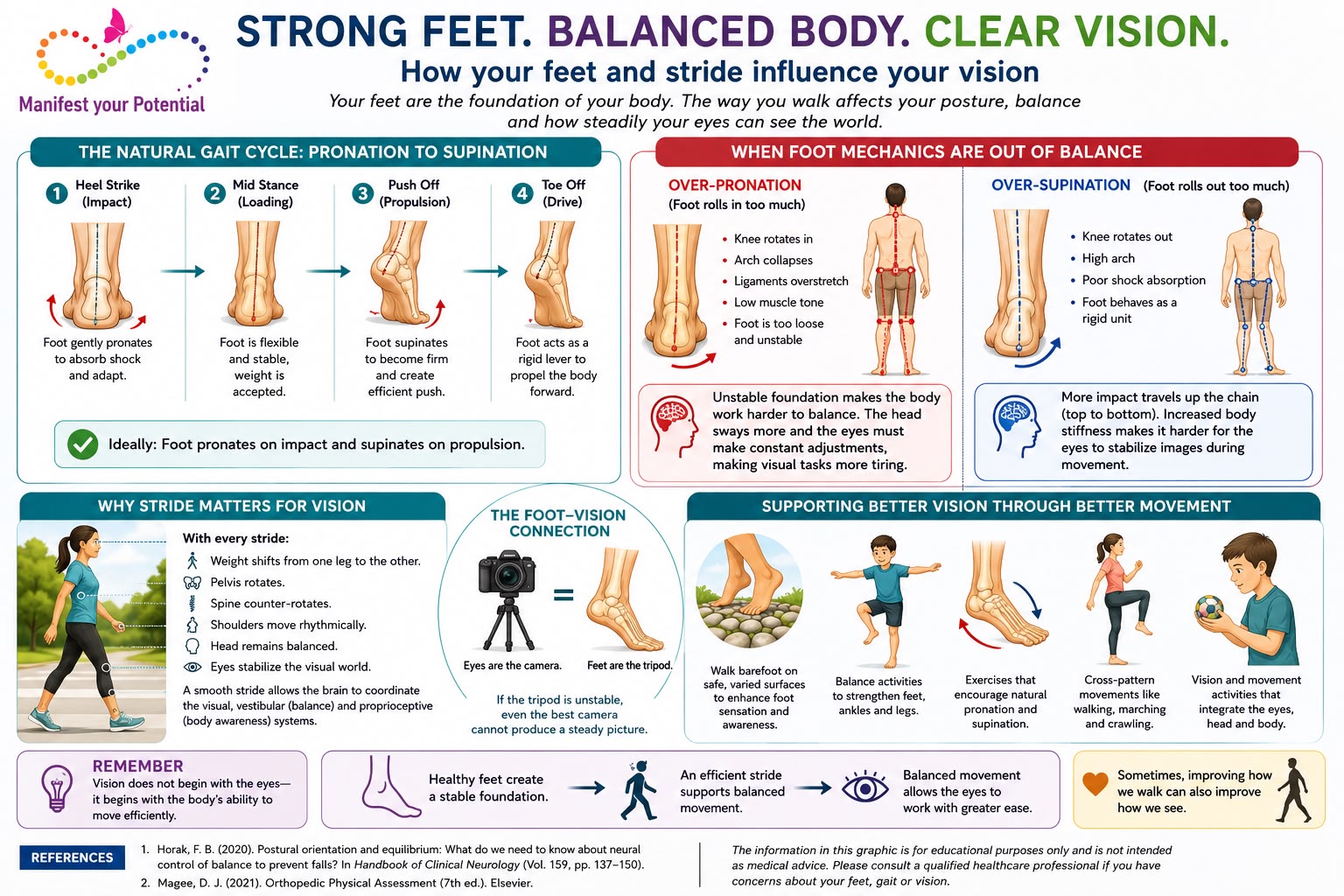
What Happens During a Normal Step?
A healthy walking pattern has two important phases:
1. Pronation – The Shock Absorber
When the heel first contacts the ground, the foot gently pronates (rolls inward slightly). This allows the foot to:
* Absorb shock
* Adapt to uneven surfaces
* Activate muscles throughout the leg
* Create a stable yet flexible base
2. Supination – The Propeller
As you push off the ground, the foot naturally supinates (rolls outward slightly). This:
* Creates a firm, stable lever
* Provides efficient propulsion
* Transfers force through the body
* Helps move the body forward with ease
Healthy walking requires both movements. The foot should be flexible when accepting weight and rigid when pushing off.
When the Foot Over-Pronates
An over-pronated foot stays excessively rolled inward.
This often leads to:
* The knee rotating inward.
* The arch collapsing.
* Ligaments becoming overstretched.
* Reduced muscle tone in the foot.
* A foot that becomes “too loose” and unstable.
Because the foot provides an unstable foundation, the body has to work harder to maintain balance. The head may sway more, forcing the eye muscles to make constant adjustments to keep vision stable.
Children and adults with excessive pronation may fatigue more easily during reading, sports, or activities that require sustained visual attention because the visual system is constantly helping compensate for reduced postural stability.
When the Foot Is Over-Supinated
An over-supinated foot remains rolled outward.
This usually causes:
* The knee to rotate outward.
* A high arch.
* Reduced shock absorption.
* The foot to behave like one rigid unit.
Although the foot feels stable, it loses its ability to adapt to the ground. More impact travels upward through the ankles, knees, hips, spine, and neck. Increased body stiffness can reduce the smooth movement of the head, making it harder for the eyes to stabilize images during walking or rapid movement.
Why Stride Matters
Walking is much more than moving from one place to another.
With every stride:
* Weight shifts from one leg to the other.
* The pelvis rotates.
* The spine counter-rotates.
* The shoulders move rhythmically.
* The head remains balanced.
* The eyes stabilize the visual world.
A smooth stride allows the brain to coordinate the vestibular (balance), proprioceptive (body awareness), and visual systems.
If the stride becomes uneven because of poor foot mechanics, the brain receives inconsistent sensory information. The eyes may have to work harder to maintain clear vision while moving, making activities such as reading while walking, catching a ball, copying from the board, or navigating busy environments more challenging.
The Foot–Vision Connection
Think of the body like a camera mounted on a tripod.
The eyes are the camera lens.
The feet are the tripod.
If the tripod is unstable, even the best camera cannot produce a steady picture.
Likewise, unstable or overly rigid feet can reduce the body’s ability to stabilize the head and eyes, making visual tasks more effortful.
Supporting Better Vision Through Better Movement
Improving foot function can positively influence posture, balance, and visual efficiency. Helpful activities may include:
* Walking barefoot on safe, varied surfaces to improve sensory awareness.
* Balance activities to strengthen the muscles of the feet and legs.
* Exercises that encourage natural pronation and supination during walking.
* Cross-pattern movements such as walking, marching, and crawling to improve whole-body coordination.
* Vision and movement activities that integrate the eyes, head, and body.
Final Thoughts
Vision does not begin with the eyes—it begins with the body’s ability to move efficiently.
Healthy feet create a stable foundation, an efficient stride supports balanced movement, and balanced movement allows the eyes to work with greater ease.
Sometimes, improving how we walk can also improve how we see.
1. Horak, F. B. (2020). Postural orientation and equilibrium: What do we need to know about neural control of balance to prevent falls? In Handbook of Clinical Neurology (Vol. 159, pp. 137–150).
2. Magee, D. J. (2021). Orthopedic Physical Assessment (7th ed.). Elsevier.
Minaz Ajani has a Master’s in Sp. Ed with a focus on Learning Disabilities. She is an Internationally Licensed Brain Gym®️ , Touch for Health®️ , Movement-Based Learning™️ and RMTI ®️ Instructor and consultant and founder of Manifest Your Potential (http://manifesturpotential.com)