

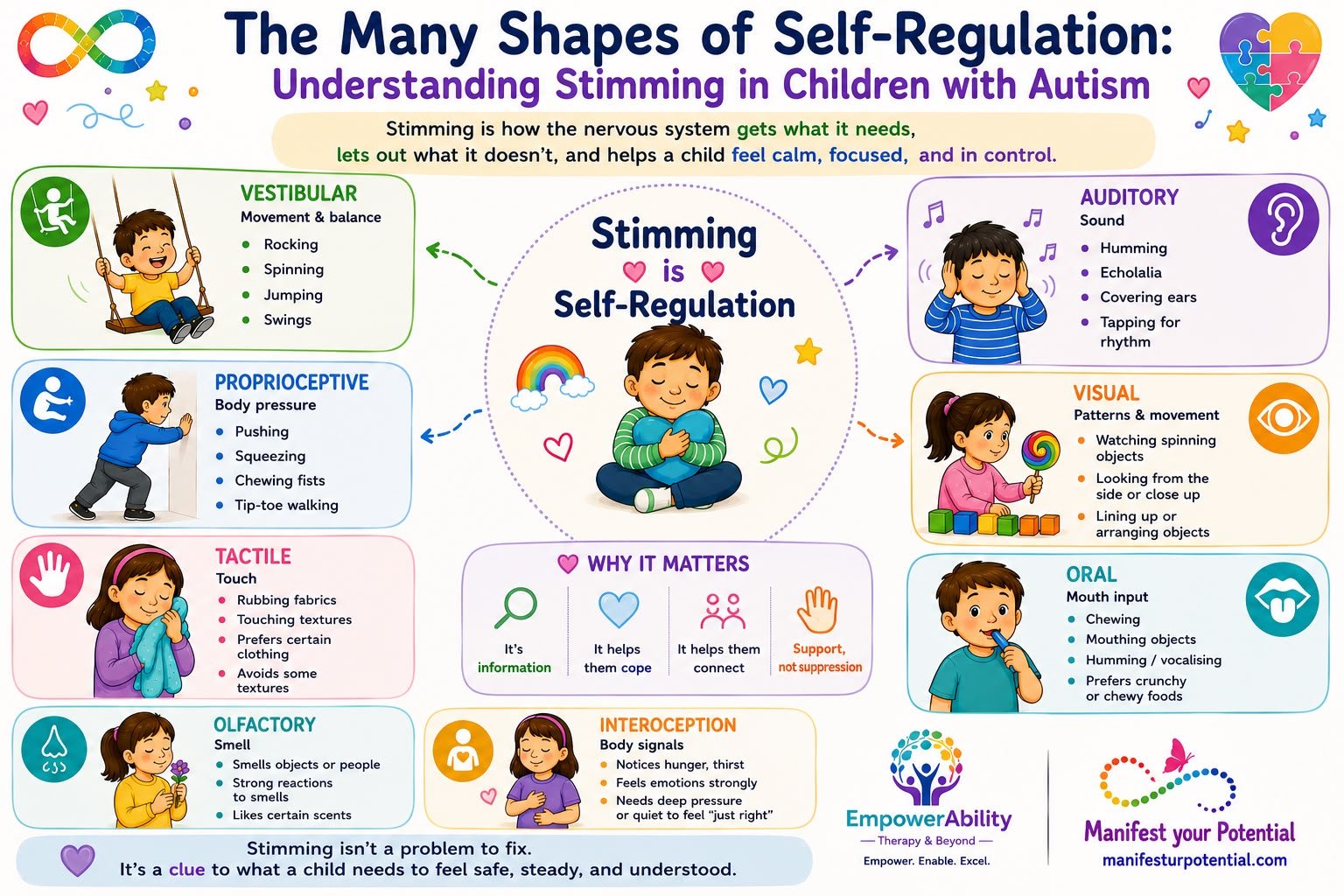
Anyone who has spent time around an autistic child has probably seen it: the hand flap during a moment of excitement, the rocking before a transition, the hum that starts up in a noisy room. These behaviours have a name — stimming, short for self-stimulatory behaviour — and they are far more purposeful than they might first appear.
Stimming isn’t a quirk to be trained away. It’s the nervous system doing its job: seeking input it needs, discharging input it doesn’t, and helping a child stay organised in a body and a world that can feel like a lot. Understanding which sense a child is regulating, and why, changes how we respond — from correction to curiosity.
Here’s a tour through the sensory channels stimming usually moves through, with the behaviours you’re most likely to recognise in each one.
Vestibular: Seeking Balance and Motion
The vestibular system, housed in the inner ear, tells us where our body is in space — upright, falling, spinning, still. Children whose nervous systems crave vestibular input often move rhythmically, because that motion is genuinely organising for them.
Look for rocking back and forth, spinning in place, repetitive jumping or bouncing, or a strong pull toward swings and rocking chairs. For some children this movement is calming; for others, it’s alerting — a way to wake the body up before a task that needs focus.
Proprioceptive: Seeking Body Pressure
Proprioception is the sense of where our joints and muscles are, fed by pressure and resistance. It’s one of the most reliably calming systems to engage, which is why so much of stimming lives here.
Common examples include arm or hand flapping, squeezing, pressing, or crashing into furniture and people, clenching the jaw or fists, and tip-toe walking. Many sensory strategies — weighted blankets, bear hugs, “wall push-ups” — work precisely because they feed this same channel in a more sustainable way.
Tactile: Seeking or Filtering Touch
The skin is a huge sensory surface, and children process touch input very differently from one another. Some seek it out; others are trying to manage too much of it.
Watch for rubbing fabric or skin, light scratching or tapping, running fingers through sand, water, or hair, or a strong preference for tight, textured, or specific-feeling clothing. A child avoiding certain textures is regulating just as much as one who’s seeking them — it’s the same system working in the other direction.
Auditory: Seeking or Managing Sound
Sound regulation cuts both ways too: children may generate sound to soothe themselves, or block it out because the environment is delivering more than they can filter.
This shows up as humming or repeating sounds, echolalia (repeating words or phrases, sometimes from shows or past conversations), rhythmically covering the ears, or tapping objects to create a steady beat. In a loud classroom or family gathering, these behaviours are often doing real work to keep a child regulated enough to stay present.
Visual: Seeking Pattern and Movement
Visual stimming often looks the most unfamiliar to adults, but it follows the same logic as everything else: the eyes are seeking predictable, patterned, or moving input.
Examples include watching spinning objects, looking at things from the side or very close up, finger-flicking near the eyes, and lining up or carefully arranging objects. That last one is worth noting — organising toys by colour or size isn’t just play; for many children, it’s a visual and cognitive stim in its own right.
Oral: Seeking Input Through the Mouth
The mouth is dense with nerve endings, which makes it an effective and common calming pathway — visible in toddlers who mouth everything, and just as present, if less talked about, in autistic children of all ages.
This includes chewing on clothing, toys, or nails, mouthing objects, humming or vocalising, and a marked preference for crunchy or chewy foods. Chew-safe jewellery and crunchy snacks are popular supports precisely because they meet this need directly.
Why It Matters
Stimming is, in most cases, a coping strategy — for managing sensory overwhelm, expressing joy, sustaining focus, or simply feeling at home in one’s own body. The goal for parents, teachers, and therapists usually isn’t to eliminate it, but to get curious: which channel is this child seeking, and what is it doing for them?
Support — rather than suppression — is worth considering when a behaviour causes injury, gets in the way of a connection or activity the child actually wants, or seems to signal distress rather than regulation. In those cases, an occupational therapist or behavioural specialist can help find a safer or more sustainable way to meet the same sensory need, in the same channel, rather than asking the nervous system to simply do without.
Seen this way, stimming stops looking like a problem to solve. It’s information — a window into what a child’s body needs, moment to moment, to feel steady.