

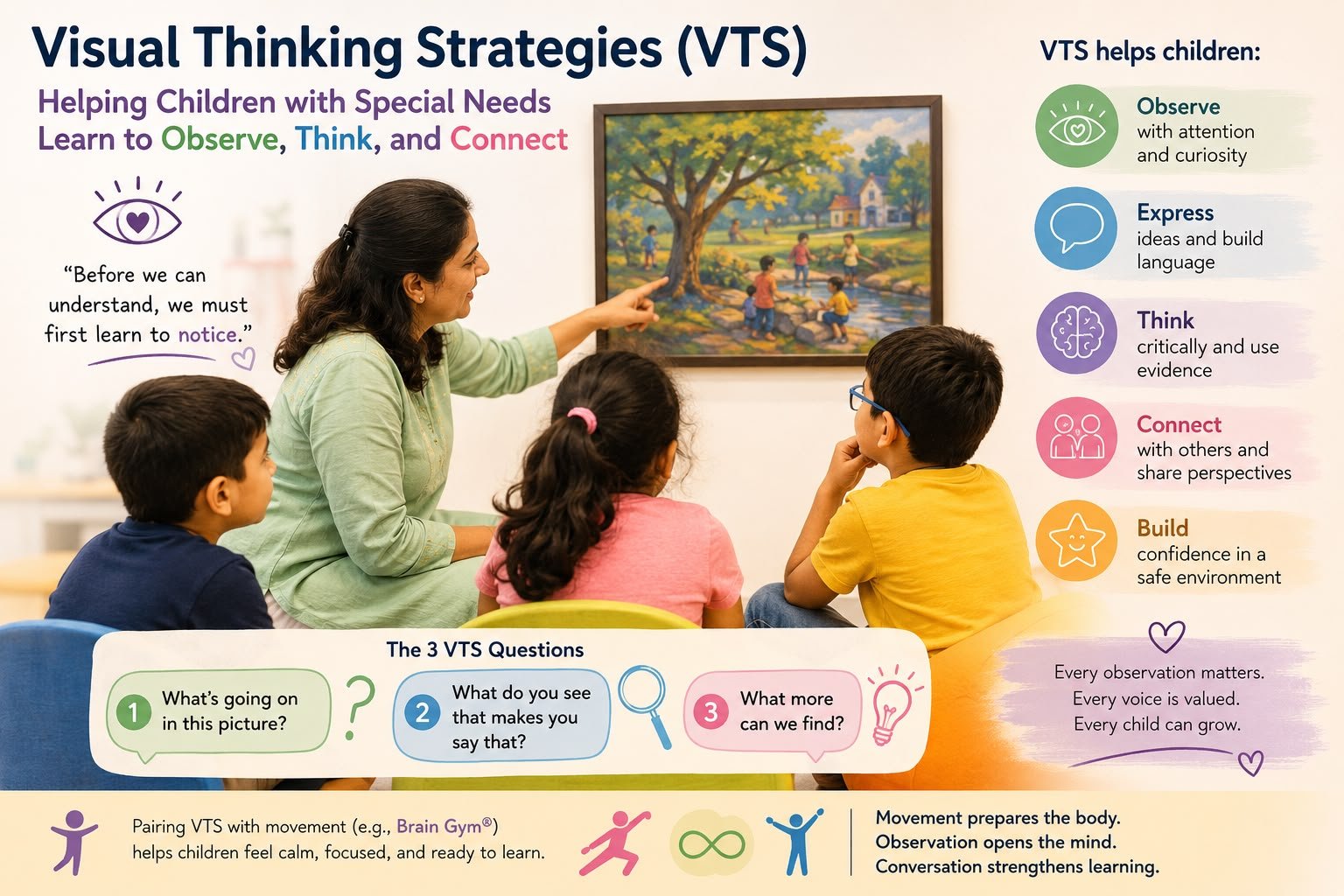
“Before we can understand, we must first learn to notice.”
Many children with special needs are quick to be asked questions like, “What’s the right answer?” or “Can you finish this task?” Yet, some of the most valuable learning begins much earlier—with simply looking, noticing, wondering, and sharing.
This is where Visual Thinking Strategies (VTS) can make a meaningful difference.
What is Visual Thinking Strategies (VTS)?
Visual Thinking Strategies is an evidence-based teaching approach that uses carefully selected images to encourage observation, reasoning, language, and discussion. Rather than teaching children what they should see, VTS invites them to discover meaning for themselves.
The process revolves around three simple questions:
1. What’s going on in this picture?
2. What do you see that makes you say that?
3. What more can we find?
There are no immediate “right” or “wrong” answers. Instead, children are encouraged to support their ideas with what they observe, while listening respectfully to different perspectives.
Why is VTS especially valuable for children with special needs?
Many children with autism, ADHD, learning disabilities, developmental delays, or language differences experience challenges with communication, attention, flexible thinking, or interpreting social situations. VTS provides a supportive environment where every observation has value.
1. Develops Observation Before Interpretation
Children often jump quickly to conclusions or focus on only one detail. VTS gently encourages them to slow down, scan the whole image, and notice details they may have overlooked.
This strengthens:
* Visual attention
* Visual discrimination
* Sustained focus
* Flexible thinking
2. Builds Language Naturally
Instead of memorizing vocabulary lists, children use language with a purpose—to describe what they see and explain their thinking.
They learn to:
* Express ideas
* Build sentences
* Expand vocabulary
* Improve narrative skills
* Listen to others
For children who are minimally verbal or use AAC, responses can be shared by pointing, selecting symbols, gestures, or assistive communication devices.
3. Encourages Evidence-Based Thinking
One of the most powerful VTS questions is:
“What do you see that makes you say that?”
This encourages children to look for evidence rather than guessing. It strengthens reasoning, problem solving, and critical thinking while teaching that ideas can be revised when new information is noticed.
4. Supports Social Communication
VTS naturally develops important social skills by helping children:
* Take turns
* Listen respectfully
* Accept different viewpoints
* Build on another person’s ideas
* Understand that people can see the same picture differently
These are valuable skills for classroom learning and everyday relationships.
5. Promotes Confidence
Many children with learning differences hesitate to answer questions because they fear making mistakes.
In VTS, the facilitator does not evaluate responses as “correct” or “incorrect.” Instead, every observation is acknowledged and explored. This reduces performance anxiety and encourages participation.
How does VTS support children with autism?
Many autistic children are excellent visual learners. VTS allows them to use this strength while gently developing communication and perspective-taking.
With thoughtful adaptations, VTS can help children:
* Notice facial expressions and body language
* Recognize emotions
* Understand social situations
* Practice flexible thinking
* Expand expressive language
* Improve joint attention
Adaptations may include:
* Allowing extra processing time
* Using simple or highly engaging images
* Accepting non-verbal responses
* Working in small groups or one-to-one settings
* Providing visual supports when needed
Combining VTS with Brain Gym®
As a Brain Gym® practitioner, I see VTS as a wonderful complement to movement-based learning.
Brain Gym movements help prepare the brain and body by supporting attention, visual comfort, bilateral integration, and self-regulation. Once children are calm and ready to learn, VTS provides an opportunity to use those skills in meaningful thinking and communication.
A simple session might look like this:
* Begin with a few Brain Gym movements such as Cross Crawl, Hook-ups, or Lazy 8s.
* Invite children to quietly observe an interesting picture.
* Guide the discussion using the three VTS questions.
* Finish with a creative activity such as drawing, storytelling, role play, or Double Doodle.
Movement prepares the learner. Observation deepens attention. Conversation strengthens thinking.
The Power of Noticing
One of the principles I often share is:
“It is impossible to change something we haven’t noticed for ourselves.”
VTS beautifully reflects this idea. It teaches children that learning begins not with rushing to answers, but with careful observation.
When we remove judgment and create space for curiosity, children become more willing to explore, think, communicate, and learn.
Sometimes the greatest gift we can offer a child is not another answer—it is the opportunity to notice.
Final Thoughts
Visual Thinking Strategies is much more than discussing pictures. It is a way of nurturing curiosity, communication, critical thinking, and confidence.
For children with special needs, VTS offers a safe and respectful learning experience where every voice matters, every observation is valued, and every child has the opportunity to grow.
When combined with movement-based approaches such as Brain Gym®, VTS becomes even more powerful—helping children prepare their bodies, focus their minds, and engage fully with the world around them.
⸻
References
* Housen, A. Aesthetic Thought, Critical Thinking and Transfer.
* Yenawine, P. Visual Thinking Strategies: Using Art to Deepen Learning Across School Disciplines.
* Housen, A., & Yenawine, P. Visual Thinking Strategies (VTS) methodology and educator resources.