
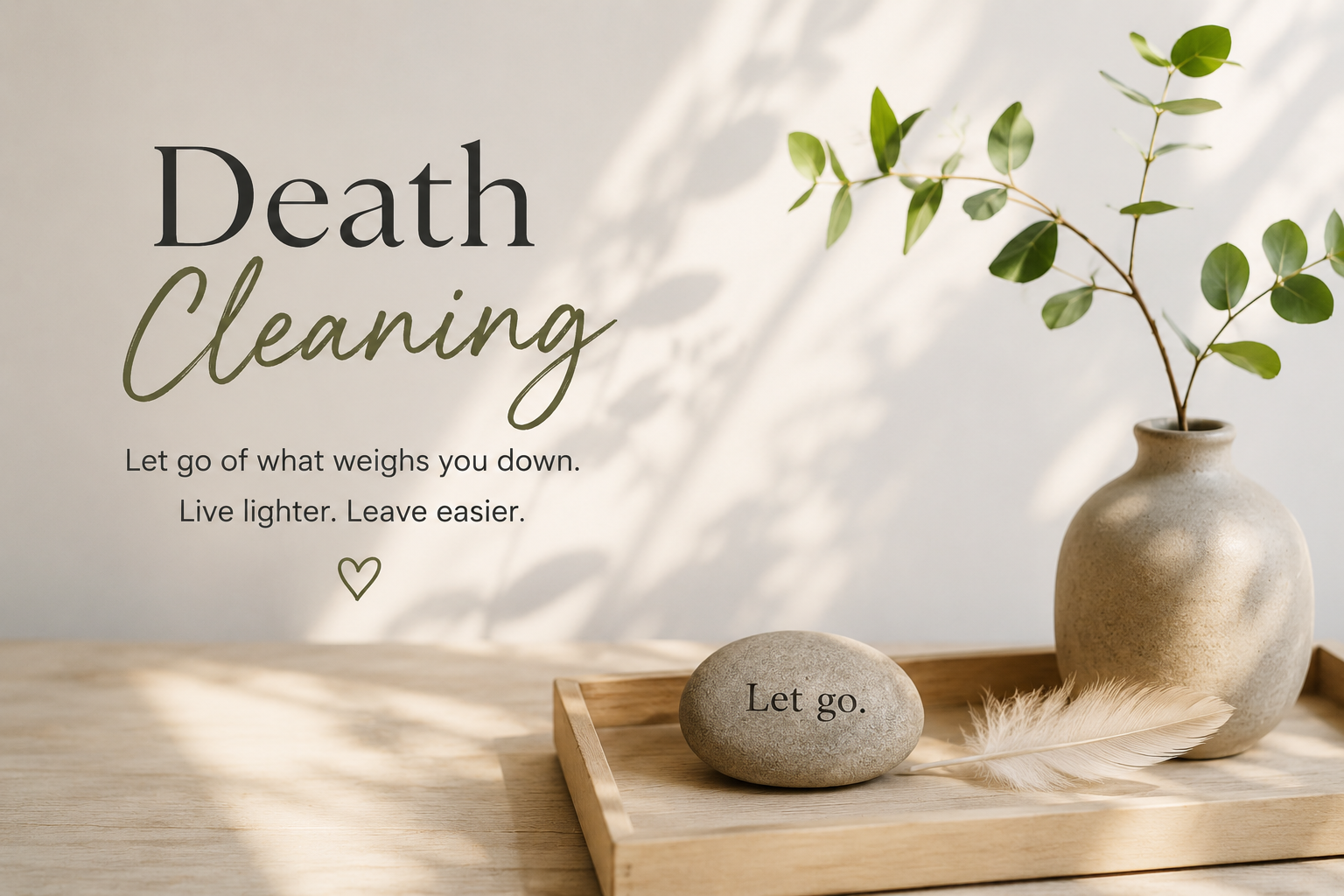
What if cleaning up your life had nothing to do with dying—and everything to do with living lighter?
The first time I came across the term “death cleaning,” I was fascinated.
It was one of those random articles that appeared in my feed. I don’t even remember where I read it, but the concept stayed with me.
For some, it might sound morbid.
Or even a little over the top.
But today, having lost one parent and living with two older people in their 80s, I understand the idea very differently.
Death cleaning is usually spoken about in terms of clothes, documents, possessions, photographs, things accumulated over decades.
What happens to my things when I’m gone?
Who will sort through them?
What will my children have to deal with?
What should I leave behind?
These are important questions.
But I think death cleaning needs to go much deeper.
It needs to include our emotions too.
Because we spend an enormous amount of our lives accumulating emotional clutter.
Anger.
Angst.
Resentment.
Old arguments.
Unfinished conversations.
People we are still trying to prove something to.
Situations we revisit in our heads years after they have actually ended.
And sometimes, we carry all of this as if we are going to get extra baggage allowance when we leave this world.
We aren’t.
I live in India, and I also recognise that our cultural fabric makes this conversation complicated.
We haven’t necessarily reached that maturity where older people can completely detach themselves from their children.
Millions of parents continue to depend on their children for emotional, physical, financial, and everyday support.
And millions of children remain deeply involved in their parents’ lives.
That’s not necessarily wrong.
Our families are built differently.
But perhaps there is a point where involvement needs to become conscious involvement.
How much do I really need to get involved in the nitty-gritty of my children’s household?
How much do I need to interfere in the lives of friends?
How much emotional energy do I want to spend on things that don’t belong to me?
This isn’t about abandoning people.
It isn’t about becoming insensitive.
It isn’t about saying, “Not my problem.”
It is about understanding what deserves my emotional bandwidth and what doesn’t.
That, to me, is also death cleaning.
What about anger?
How much anger are you planning to carry with you?
That person hurt you ten years ago.
The incident happened.
You were wronged.
You were angry.
Fair enough.
But are you still carrying it?
At some point, perhaps death cleaning means looking at that memory and saying:
“This happened. It mattered. I learnt from it. But I don’t need to carry it anymore.”
Neutral doesn’t mean forgiveness.
Neutral simply means free.
And then there is the larger world.
The political climate.
Religious debates.
Social media outrage.
Where society is heading.
What somebody said.
What somebody didn’t say.
Who is right.
Who is wrong.
There is always something to be agitated about.
And I sometimes wonder:
How much of this do we actually need to take into our own lives?
We have finite emotional bandwidth.
Why are we spending it so freely?
The original article I read, if I remember correctly, spoke about death cleaning around the age of 50.
I agree that 50 is probably a good time to start.
But honestly?
You don’t need a number.
You need awareness.
Maybe you do it every year.
Maybe every month.
Maybe every Saturday.
For me, interestingly, Saturday has become my little ritual.
I clean my cupboard.
I still have beautiful things I’ve collected over the years. Things I love. Things with memories attached to them.
But every time I clean, I find something I am ready to let go of.
And slowly, I have learnt something I wasn’t particularly good at earlier:
Detachment.
Not because the things don’t matter.
But because they don’t need to own me.
And perhaps that’s what death cleaning really is.
Not simply deciding what happens to your belongings after you die.
It is deciding what you don’t want to carry while you are still alive.
The old anger.
The unnecessary relationships.
The constant need to be right.
The emotional drama.
The guilt.
The clutter.
The things that have served their purpose.
The thoughts that have stopped serving you.
The people who consistently bring misery.
The situations that consume you without giving anything back.
Clean.
Declutter.
Detach.
Not once.
Not at 50.
Not when you get a diagnosis.
Not when someone close to you dies.
Whenever you realise you are carrying something you no longer need.
Perhaps you don’t need to be old to understand this.
You need to be an older soul.
Numerical age doesn’t matter.
Soul age might.
And whether you call it death cleaning or simply cleaning up your life…
Clean you must.
Your cupboard.
Your thoughts.
Your relationships.
Your emotions.
Your expectations.
Your stuff.
Because when the time comes to leave, wouldn’t it be wonderful to leave with very little unfinished business?
And until then…
Wouldn’t it be even better to live with a little less of it?