

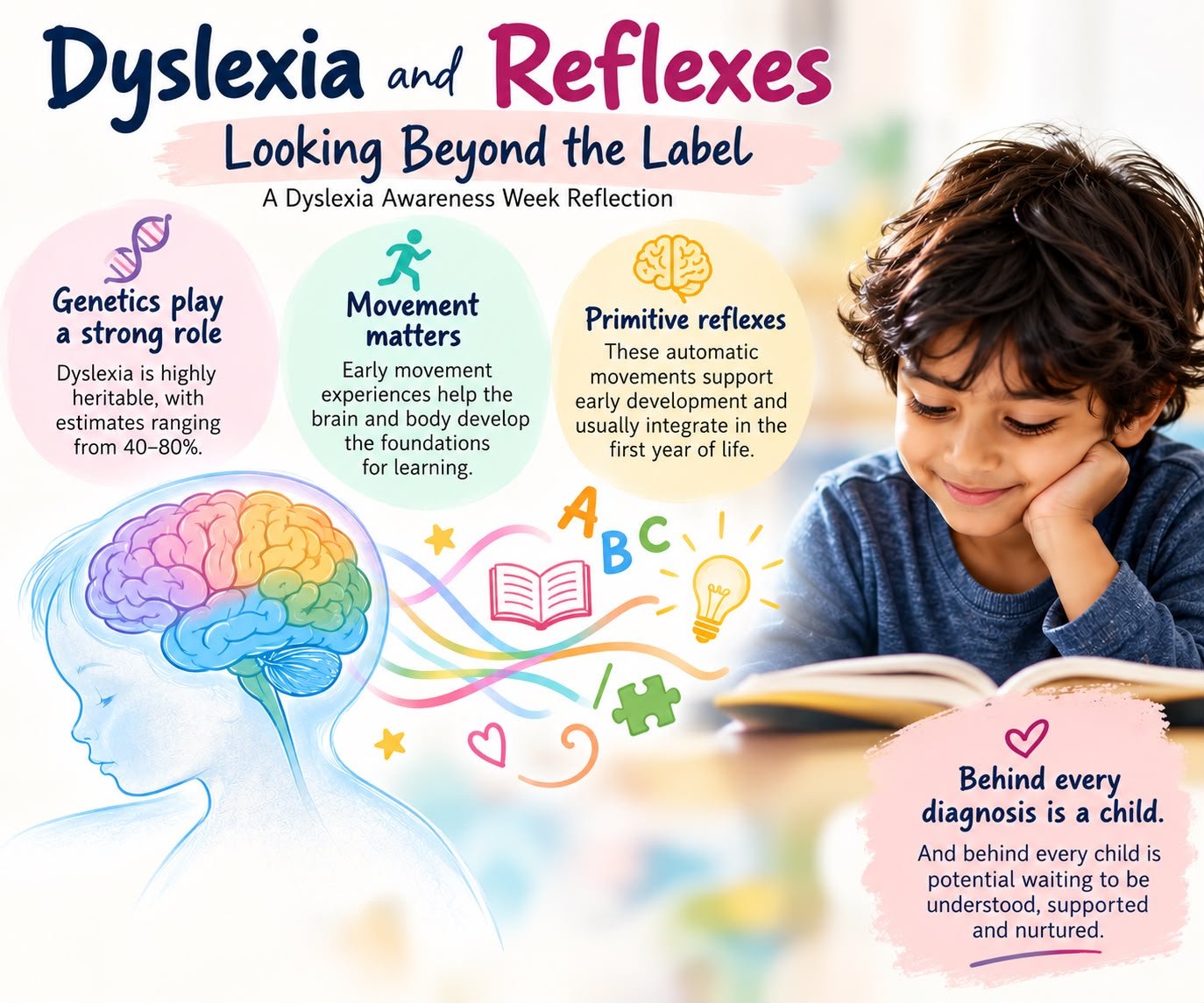
A Dyslexia Awareness Month Reflection
The questions come to us again and again:
What causes ADHD? What causes Autism? Dyslexia? Dyspraxia?
Parents ask. Teachers ask. And we understand why.
We all want a simple answer—the one explanation that will make everything clear.
Unfortunately, there isn’t one.
This Dyslexia Awareness Month, let’s look at dyslexia from both a research-based and movement-based perspective.
Dyslexia is complex
Dyslexia is a neurodevelopmental learning difference that primarily affects reading and spelling. It is not related to intelligence, laziness or lack of effort.
Research shows that dyslexia has a strong genetic component. Reading ability and dyslexia are highly inheritable, with estimates generally ranging from 40–80%, depending on the skill being studied.
Having a close family member with reading difficulties is one of the strongest known risk factors.
But genes are only part of the developmental story.
What about movement and primitive reflexes?
Before a child learns to read and write, the brain and body are busy developing the foundations for learning—posture, balance, coordination, eye-hand coordination, bilateral movement and sensory processing.
Primitive reflexes are automatic movements present during infancy. They play an important role in early survival and development and, as the nervous system matures, they are gradually inhibited or integrated.
Sometimes, children may show signs of retained or strongly active primitive reflex patterns.
This does not mean that retained reflexes cause dyslexia.
However, some movement-based practitioners believe that exploring reflex patterns can provide additional information about a child’s motor and sensory development.
Two reflexes we often look at
TLR – Tonic Labyrinthine Reflex
The TLR is involved in early development of muscle tone and postural control.
As children grow, they need to develop the ability to maintain posture and balance without relying on early automatic patterns.
ATNR – Asymmetrical Tonic Neck Reflex
Often called the “fencing reflex,” the ATNR is activated when a baby turns their head to one side. It is associated with early development of reaching, eye-hand coordination and movement between the two sides of the body.
As children develop, these automatic patterns become increasingly integrated with voluntary movement.
Why does this matter for learning?
Imagine a child who is working hard just to sit comfortably, coordinate both sides of the body, track across a page or maintain attention.
For that child, learning may require much more effort than we can see.
This is why it can be helpful to look beyond the academic difficulty.
Instead of asking only:
“Why can’t this child read?”
we can also ask:
“What foundations does this child need to make learning easier?”
One important message
Primitive reflexes are one piece of a much bigger picture.
They should never be presented as the single cause of dyslexia, nor should movement-based approaches replace appropriate assessment and evidence-based literacy intervention.
But movement, posture, coordination and sensory development can give us another lens through which to understand the child.
Because behind every diagnosis is a child.
And behind every child is potential waiting to be understood, supported and nurtured.
This Dyslexia Awareness Week, let’s move beyond the label.
Don’t just ask, “What’s wrong?”
Ask:
“What does this child need?”
Manifest Your Potential
EmpowerAbility
Unlocking potential through movement, understanding and purposeful support.
www.manifesturpotential.com
Reference:
Dempsey, Moira. Movement Matters: A Movement-Based Approach to ADHD, Autism, Dyslexia and Dyspraxia.