

“It’s not that they won’t. It’s that they can’t—yet.”
Have you ever watched a child who seems bright, curious, and eager to learn, yet struggles to tie shoelaces, catch a ball, write neatly, or keep up with their peers during sports? They may appear clumsy, disorganized, or even lazy. But what if their brain simply finds it harder to plan and organize movement?
This is often the hidden reality of Dyspraxia, also known as Developmental Coordination Disorder (DCD).
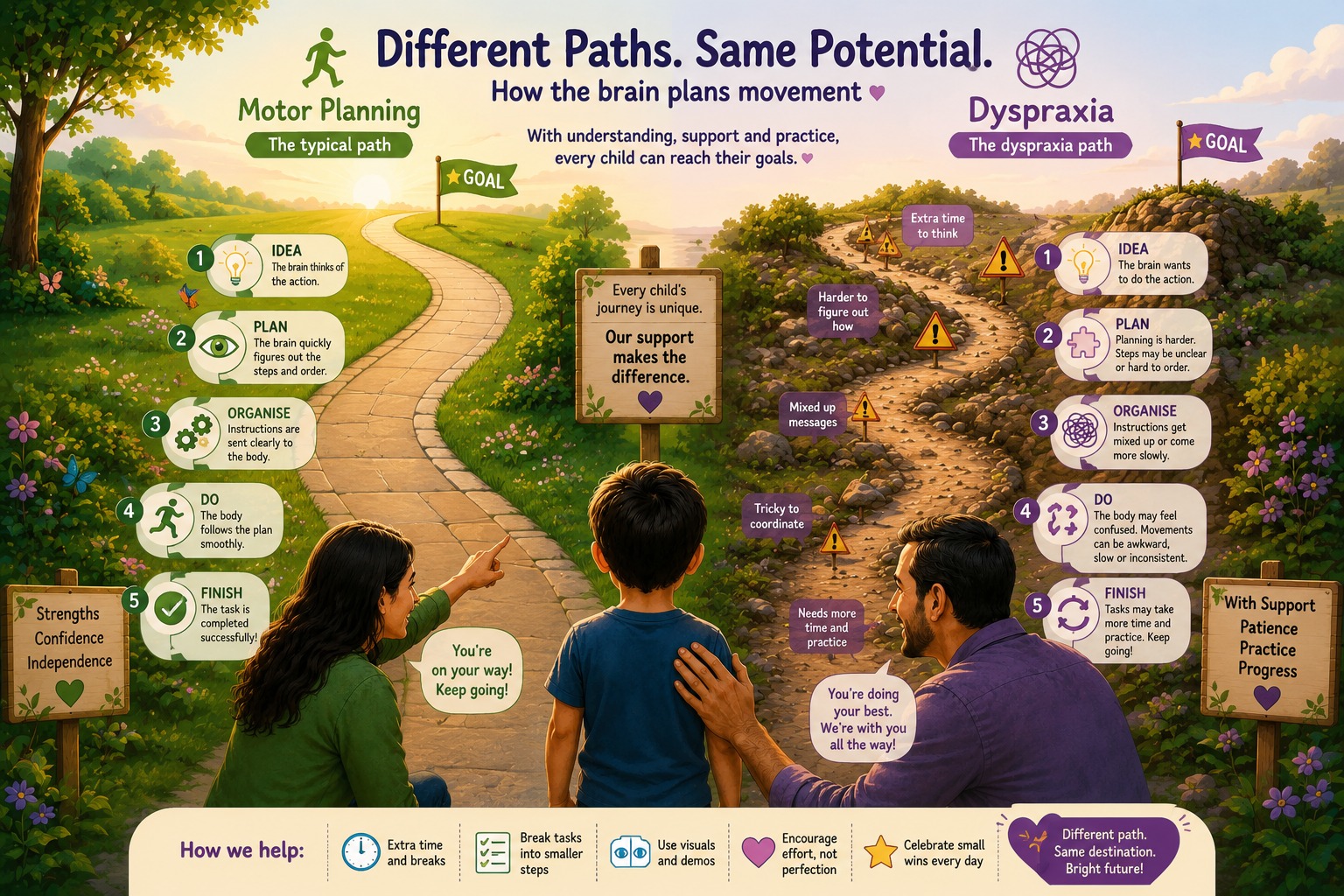
Dyspraxia is far more than being “clumsy.” It is a neurological difference that affects how the brain plans, sequences, and carries out movements. These challenges can influence a child’s confidence, learning, social interactions, and everyday independence.
What is Dyspraxia?
Praxis is our ability to:
* Think of an idea.
* Plan the movement.
* Organize the sequence.
* Carry it out smoothly.
* Adapt if something changes.
Children with dyspraxia often know exactly what they want to do, but the message from the brain to the body is less efficient. The result is movements that may appear awkward, slow, poorly coordinated, or effortful.
Imagine trying to assemble furniture without instructions while someone keeps changing the pieces. That is similar to what movement planning can feel like for someone with dyspraxia.
Signs You Might Notice
Every child is unique, but common signs include:
Gross Motor Skills
* Frequent tripping or bumping into objects
* Difficulty running, hopping, skipping, or balancing
* Poor ball skills
* Avoiding playground activities or sports
* Difficulty learning to ride a bicycle
Fine Motor Skills
* Messy or slow handwriting
* Difficulty using scissors
* Challenges with buttons, zippers, or tying shoelaces
* Trouble manipulating small objects
Daily Living Skills
* Difficulty getting dressed independently
* Taking longer to complete everyday tasks
* Struggling with organizing belongings
* Frequently forgetting the steps in a routine
Learning and Classroom Challenges
* Difficulty copying from the board
* Poor posture while sitting
* Slow completion of written work
* Trouble following multi-step instructions
* Fatigue from tasks that require sustained effort
Social and Emotional Impact
Children with dyspraxia often experience repeated failure despite trying hard. Over time they may:
* Lose confidence
* Avoid new activities
* Become anxious
* Feel frustrated
* Be misunderstood as lazy or careless
The emotional impact can sometimes be greater than the movement difficulties themselves.
Why Does Dyspraxia Happen?
Dyspraxia is believed to arise from differences in how the brain develops and processes information involved in movement planning. Researchers are still learning about the exact causes, but it is not caused by poor parenting, lack of motivation, or low intelligence.
Many individuals with dyspraxia are highly creative, intelligent, and excellent problem-solvers. Their brains simply process movement differently.
Dyspraxia Is More Than Movement
Movement is closely connected to learning.
When children have to concentrate on simply sitting upright, holding a pencil, or coordinating their eyes and hands, they have less mental energy available for reading, writing, listening, remembering, and problem-solving.
This is why supporting movement can often improve participation, confidence, and learning readiness.
Looking Beyond the Symptoms
Movement challenges rarely occur in isolation.
It is important to consider:
* Primitive reflex integration
* Postural control
* Vestibular processing
* Proprioceptive awareness
* Visual skills
* Bilateral coordination
* Sensory processing
* Motor planning
* Emotional regulation
When we understand the foundations that support movement, interventions become more meaningful and individualized.
How Can We Help?
Children with dyspraxia thrive when adults focus on building skills rather than highlighting difficulties.
Helpful strategies include:
* Break tasks into smaller steps.
* Give extra time to learn new motor skills.
* Encourage movement-based learning.
* Strengthen balance, coordination, and body awareness.
* Provide opportunities for success.
* Use visual demonstrations instead of relying only on verbal instructions.
* Celebrate effort rather than perfection.
Many children also benefit from working with occupational therapists, physiotherapists, special educators, and movement specialists who understand the relationship between movement and learning.
A Strength-Based Perspective
Children with dyspraxia often develop remarkable resilience, creativity, empathy, and determination. Many become excellent thinkers because they have learned to approach problems from different angles.
Our goal is not simply to improve coordination.
Our goal is to help children feel capable, confident, and successful in their own bodies.
When we change our understanding, we change the child’s experience.
Instead of asking,
“Why is this child so clumsy?”
Perhaps we can ask,
“What support does this child’s nervous system need to move, learn, and thrive?”
That single shift in perspective can make all the difference.