

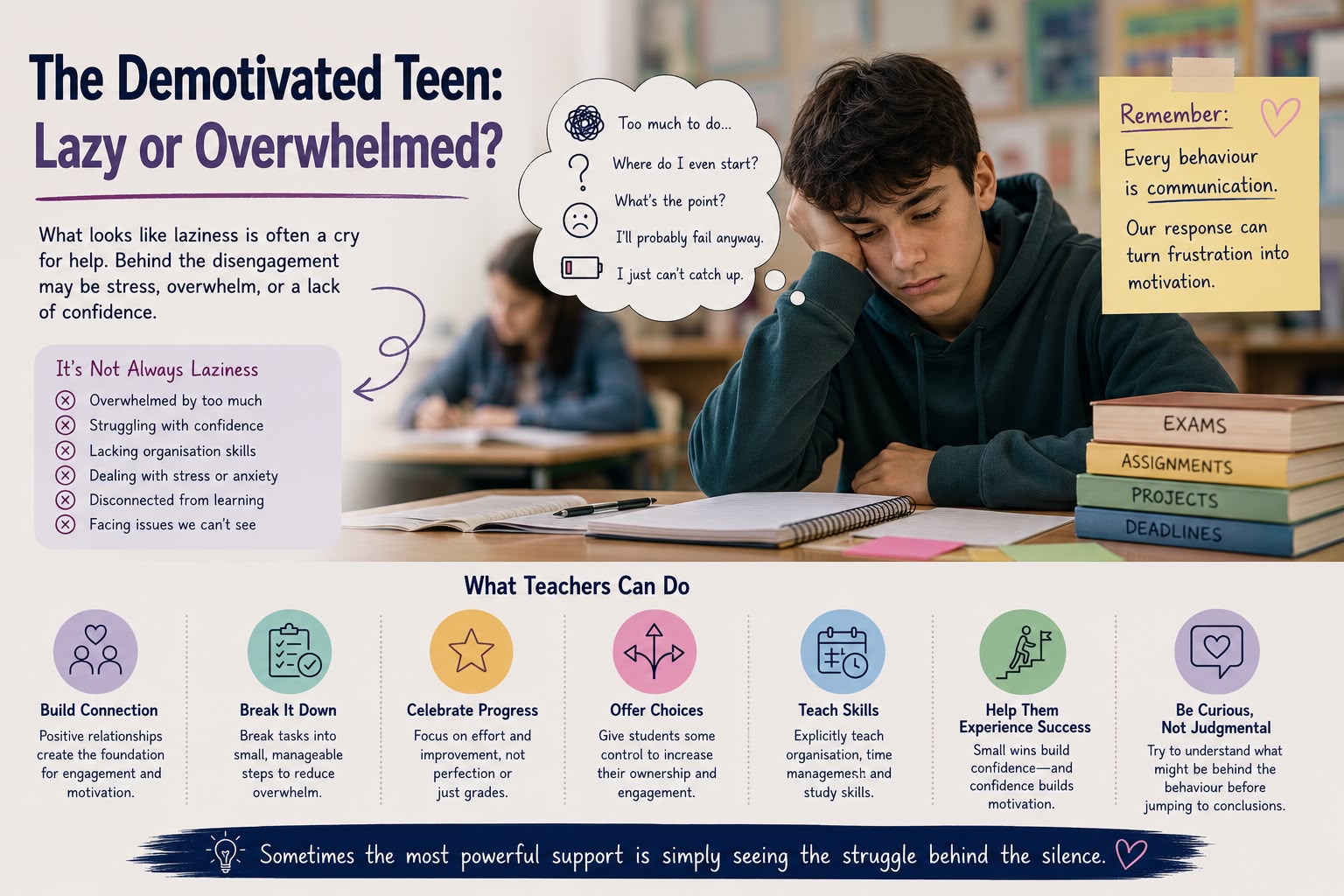
“He has so much potential, but he just doesn’t apply himself.”
“She’s capable of doing the work, but she never seems motivated.”
“He doesn’t care about anything.”
These are common statements heard in staff rooms and parent-teacher meetings. When teenagers stop completing assignments, appear disengaged in class, or seem indifferent to their performance, it is easy to conclude that they are simply lazy.
But what if what looks like laziness is actually a sign of something deeper?
Looking Beyond the Label
The word “lazy” suggests that a student is choosing not to put in effort. However, many teenagers who appear unmotivated are often struggling with challenges that are not immediately visible.
They may be:
* Feeling overwhelmed by academic demands
* Experiencing anxiety or stress
* Lacking confidence in their abilities
* Struggling with executive functioning skills
* Coping with social pressures
* Dealing with sleep deprivation
* Feeling disconnected from what they are learning
When we label students as lazy, we risk overlooking the factors that may be affecting their ability to engage and succeed.
The Teenage Brain and Motivation
Adolescence is a period of significant brain development. The parts of the brain involved in planning, organisation, self-monitoring, and long-term goal setting are still maturing.
This means that teenagers may:
* Struggle to start tasks
* Procrastinate even when they know a task is important
* Underestimate how long assignments will take
* Have difficulty prioritising
* Need more support with organisation than adults expect
A student’s inability to begin a task is not always a sign of unwillingness. Sometimes it is a sign that they do not yet have the skills to manage the task effectively.
When Overwhelm Looks Like Laziness
Imagine a student who has four assignments due, upcoming exams, extracurricular commitments, and social pressures.
Instead of tackling the workload, the student spends hours scrolling on their phone.
To adults, this may appear irresponsible.
However, overwhelm often causes people to avoid tasks that feel too large, too difficult, or too stressful. The brain seeks immediate comfort and distraction when demands feel unmanageable.
The student may not be avoiding work because they do not care. They may be avoiding work because they do care and feel incapable of coping.
Signs a Student May Be Overwhelmed
Teachers may notice:
* Frequent incomplete assignments
* Difficulty getting started
* Daydreaming or appearing distracted
* Avoidance behaviours
* Increased irritability
* Perfectionism
* Negative self-talk
* Giving up quickly when work becomes challenging
Many overwhelmed students quietly believe:
“What’s the point? I’ll probably get it wrong anyway.”
The Role of Confidence
Motivation and confidence are closely connected.
Students are more likely to engage when they believe they can be successful.
Consider two students faced with the same assignment:
Student A believes:
“I can figure this out.”
Student B believes:
“I’m going to fail.”
Which student is more likely to begin?
A lack of confidence often leads to avoidance, which can be mistaken for laziness.
What Teachers Can Do
1. Build Connection Before Correction
Students are more likely to engage when they feel seen and understood.
Simple actions matter:
* Greet students by name.
* Notice their strengths.
* Show interest in their lives.
* Acknowledge effort, not just achievement.
Connection often becomes the foundation for motivation.
2. Break Large Tasks into Smaller Steps
A lengthy project can feel overwhelming.
Instead of saying:
“Complete the research project by Friday.”
Try:
* Step 1: Choose a topic.
* Step 2: Find three sources.
* Step 3: Create an outline.
* Step 4: Write the introduction.
Small successes create momentum.
3. Focus on Progress Rather Than Perfection
Some students avoid tasks because they fear making mistakes.
Encourage a growth mindset by emphasizing:
* Effort
* Improvement
* Learning from mistakes
Celebrate progress, even when it is small.
4. Provide Choices
Teenagers are developing independence and autonomy.
Whenever possible, offer choices:
* Topic choices
* Project formats
* Ways to demonstrate learning
Choice increases ownership and engagement.
5. Teach Organisational Skills Explicitly
Many students need support with:
* Time management
* Planning
* Prioritising tasks
* Breaking down assignments
These skills should be taught, modelled, and practised rather than assumed.
6. Help Students Experience Success
Motivation grows when students experience competence.
Look for opportunities where students can:
* Use their strengths
* Achieve manageable goals
* Build confidence gradually
Success often creates motivation more effectively than pressure.
7. Consider What the Behaviour May Be Communicating
Instead of asking:
“Why is this student so lazy?”
Try asking:
“What might be making it difficult for this student to engage?”
This shift in perspective often leads to more effective responses.
A Classroom Example
A teacher becomes frustrated because Rahul rarely submits homework and seems uninterested during lessons.
Rather than assuming he is lazy, the teacher decides to have a conversation.
She discovers that Rahul spends several hours each evening helping at his family’s business and often begins homework late at night when he is exhausted.
Together, they develop a plan:
* Breaking assignments into smaller parts
* Setting realistic deadlines
* Providing occasional check-ins
Over time, Rahul’s participation improves.
The behaviour did not change because he suddenly became motivated. It changed because an adult took the time to understand the challenge behind the behaviour.
Final Thoughts
Most teenagers want to succeed. They want to feel capable, accepted, and valued. When motivation seems absent, it is worth asking whether the student is truly unwilling or whether they are struggling with challenges we cannot immediately see.
By replacing labels with curiosity and judgement with understanding, teachers can create classrooms where students feel supported rather than criticised.
Sometimes the teenager who appears lazy is actually overwhelmed, discouraged, or unsure where to begin. And sometimes, the most powerful intervention is a teacher who sees beyond the behaviour and helps the student take the first step forward.
Minaz Ajani has a Master’s in Special Education with a focus on Learning Disabilities, a Postgraduate Diploma in Counselling Psychology, International Licensed Brain Gym ®️, Touch For Health, Movement-Based Learning and RMti Instructor and Consultant