
What Happens to the Brain Under Stress — And How Learning Comes Back When the Brain Feels Safe
Have you ever noticed that when a child is stressed, anxious, overwhelmed, or scared… learning seems to stop?
You explain something again and again, but it just doesn’t “go in.”
It’s not because the child is unwilling.
It’s because the brain under stress works very differently.
The Brain Under Stress
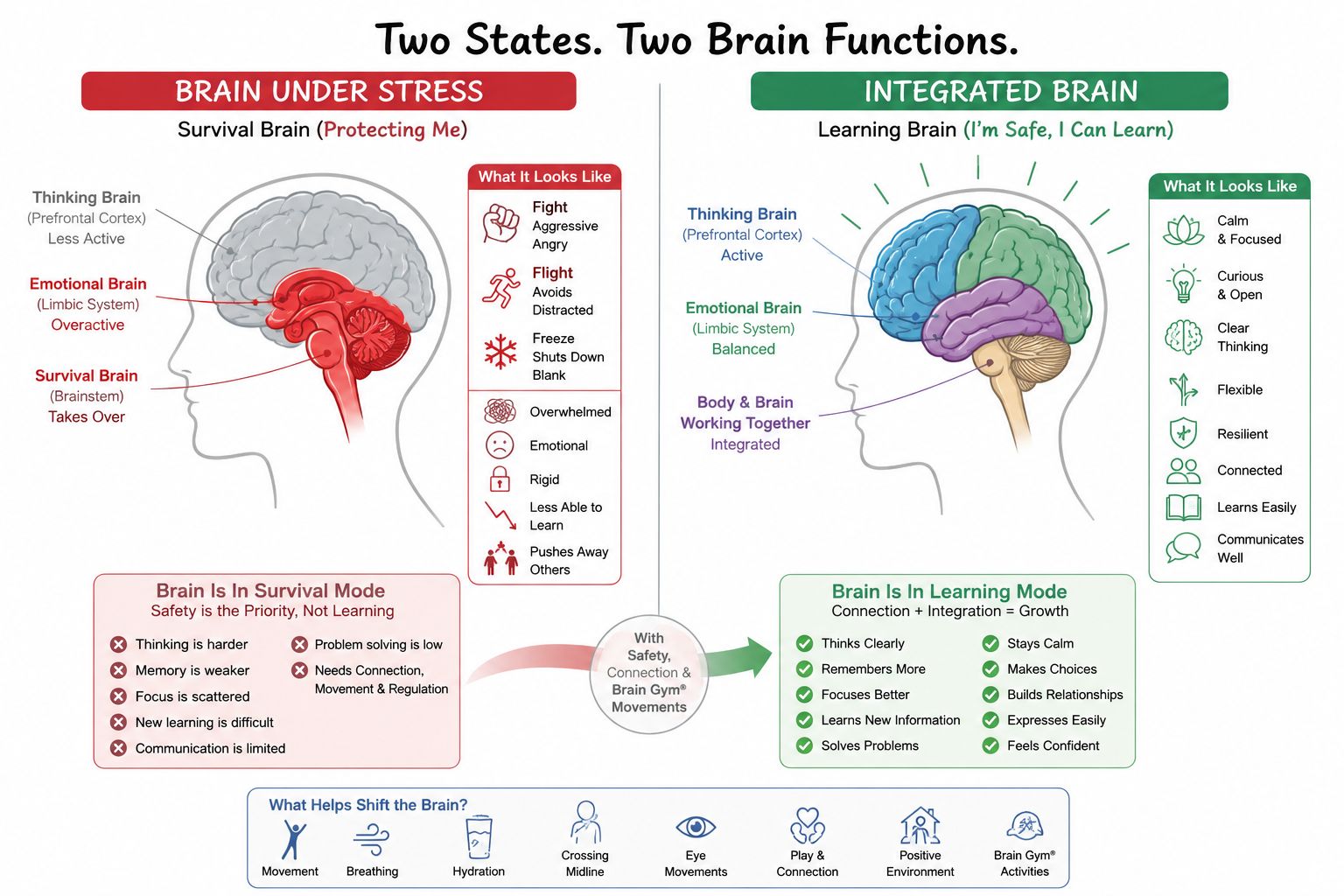
When the brain senses stress or threat, it shifts into survival mode.
Instead of focusing on learning, creativity, communication, and problem-solving, the brain asks only one question:
“Am I safe?”
At this point, the lower parts of the brain take charge.
What might this look like?
A child may:
- Freeze and seem blank
- Become aggressive or argumentative
- Refuse to cooperate
- Shut down emotionally
- Say, “I don’t get it!”
- Forget something they knew before
- Seem unable to move forward
- Avoid eye contact
- Withdraw from interaction
This is often called the fight, flight, or freeze response.
In this state:
- The thinking brain becomes less active
- Decision-making becomes harder
- Communication reduces
- New learning becomes difficult
- Memory retrieval becomes poor
The child is not “being difficult”, the brain is simply protecting itself.
The Dynamic Brain in Action
Now imagine the same child feeling calm, safe, connected, and regulated.
What changes?
The whole brain begins to work together.
Now the child can:
✔ Listen and notice
✔ Communicate openly
✔ Make choices
✔ Solve problems
✔ Try new experiences
✔ Build relationships
✔ Remember previous learning
✔ Store new information
✔ Respond instead of react
✔ Move with confidence
This is what we call a dynamic, integrated brain state . In this state learning becomes possible again.
Why This Matters for Parents and Educators
Sometimes we focus only on teaching harder.
More repetitions. More instructions. More corrections.
But if the brain is in survival mode, teaching alone won’t help.
Connection must come before correction. A stressed brain needs regulation before education.
This could mean:
- movement breaks
- breathing
- hydration
- sensory support
- eye relaxation activities
- emotional reassurance
- playful connection
Once the nervous system feels safe, the brain becomes available for learning again.
A Simple Thought to Remember
When a child cannot learn, ask:
“Is this a learning problem… or a stress response?”
Because often, what looks like resistance is actually overwhelm.
And when we help the brain feel safe, growth follows naturally.
Final Thought:
A calm brain learns. A stressed brain survives.
Reference: The concept of The Brain under stress and The Dynamic brain is taught is Brain Gym®101: Balance for Daily Life by Paul E Dennison & Gail E Dennison.
Minaz Ajani -M. Ed (Sp. Ed) LD., is an accomplished Educator and International Faculty member of Breakthroughs International, Home of the Brain Gym® program. She is a licensed Brain Gym®, Touch for Health®, RMTi and Movement-Based Learning instructor and consultant.