
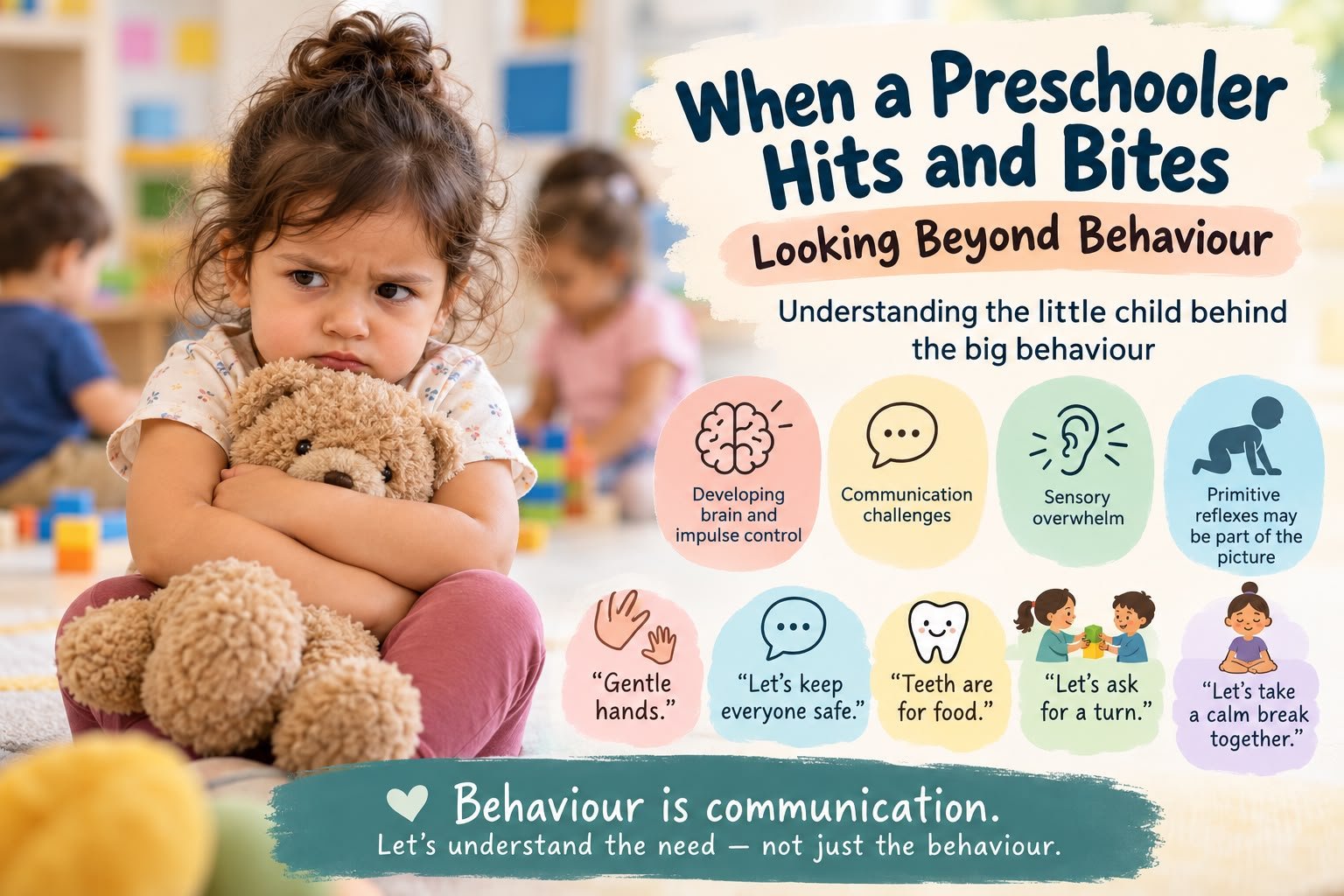
Understanding the little child behind the big behaviour
A two-and-a-half-year-old child is hitting classmates, biting other children and perhaps even lashing out at teachers.
Parents are worried. Teachers are struggling to manage the behaviour. Other parents are beginning to complain.
And somewhere in the middle of all this is a little child who may not yet have the words, emotional regulation or coping skills to express what is happening inside.
The questions we often hear are:
“Why does this child keep hitting?”
“Why does the child bite even after being told not to?”
“Are the parents not setting boundaries?”
Before we label a child as aggressive, naughty or difficult, perhaps we need to pause and ask a different question:
What is this child’s behaviour trying to communicate?
At two and a half, the brain is still developing
At this age, children are still developing their language, impulse control, emotional regulation and ability to manage frustration.
Imagine wanting a toy but not knowing how to ask for it. Imagine feeling overwhelmed by noise, struggling to wait for your turn or being unable to express that someone has come too close.
A young child may react physically because they have not yet developed the skills to manage the situation differently.
Hitting and biting may be associated with frustration, excitement, sensory needs, tiredness, communication difficulties or challenges with transitions.
Our responsibility is to protect everyone while helping the child learn safer ways to communicate.
Could primitive reflexes be part of the picture?
Primitive reflexes are automatic movement responses that emerge during early development. They play a role in infancy and typically become less dominant as the nervous system matures and voluntary movement develops.
Sometimes, persistent primitive reflex responses are explored as part of a broader developmental assessment, particularly when a child has other movement or developmental difficulties.
For example, the Moro reflex is an early response associated with sudden changes in stimulation. The Tonic Labyrinthine Reflex (TLR) is associated with head position, muscle tone and early postural patterns.
In movement-based developmental approaches, practitioners may explore these reflexes when considering a child’s overall developmental profile.
However, hitting and biting alone do not establish that a primitive reflex is unintegrated. There is no established evidence that a retained Moro reflex or TLR directly causes aggressive behaviour.
A child who bites may need help with communication, sensory regulation, emotional development or other needs. Primitive reflexes are one possible area to explore when appropriate, not a diagnosis based on behaviour.
The most important question remains: What support does this child need to participate, communicate and feel safe?
What might the child be experiencing?
A busy preschool can be full of sensory experiences: loud voices, music, movement, crowded spaces, waiting, sharing and frequent transitions.
Some children find these experiences difficult to manage. Others may struggle to express their needs or cope with frustration.
For example:
* A child may bite when another child takes a favourite toy.
* A child may push when feeling crowded.
* A child may hit when unable to communicate what they want.
* A child may become unsettled during noisy group activities.
These are possibilities to explore, not conclusions to assume.
Instead of asking only, “How do we stop this behaviour?”, let us also ask, “What skill can we help this child develop?”
How can parents and teachers respond?
Young children need loving relationships, clear boundaries and repeated opportunities to practise new skills.
The words we use matter. Instead of focusing only on what a child must stop doing, we can show them what they can do instead.
1. Use positive, simple language
When a child hits, calmly block the action if necessary and say:
* “Gentle hands.”
* “Let’s keep everyone safe.”
* “You can show me with your words.”
* “Let’s touch gently.”
When a child bites:
* “Let’s keep our friends safe.”
* “Teeth are for food. You can bite your teether.”
* “Show me what you need.”
When a child grabs a toy:
* “Let’s ask for a turn.”
* “You can say, ‘My turn, please.’”
* “Let’s wait together.”
When a child is frustrated:
* “You’re upset. I’m here to help.”
* “Let’s find another way.”
* “Show me what you need.”
When a child is overwhelmed:
* “Let’s take a quiet break together.”
* “Let’s find a calm space.”
* “Would you like to sit with me?”
These phrases offer a positive direction. They help the child understand what to do, rather than simply hearing what not to do.
Positive language does not mean allowing unsafe behaviour. If a child is about to bite or hit someone, the adult must act immediately to protect the children, using calm words and clear physical boundaries.
2. Look for patterns
Parents and teachers can observe when the behaviour occurs.
Does it happen when the child is tired, hungry, frustrated or overstimulated? Does it happen during transitions or when another child takes a toy? Is the child struggling to communicate?
A simple behaviour diary can help identify patterns and guide appropriate support.
3. Offer opportunities for movement and play
Depending on the child’s needs, supervised activities such as crawling through a play tunnel, pushing a soft cushion, playing with play dough, carrying lightweight toys or climbing safely may offer opportunities for movement and regulation.
Predictable routines, quiet spaces and supported transitions can also help.
These activities may support participation and regulation, but should not be presented as guaranteed methods for integrating primitive reflexes or eliminating biting.
4. Teach the skills the child is still developing
A toddler may need help learning to:
* Ask for a toy.
* Wait for a turn.
* Express frustration.
* Recognise simple feelings.
* Seek adult help.
* Play alongside other children safely.
These skills develop through repetition, modelling, play and consistent adult support.
5. Seek professional guidance when needed
If the behaviour is frequent, intense, persistent or affecting the child’s participation in preschool, parents should discuss their concerns with a paediatrician.
Depending on the child’s needs, a developmental assessment may explore communication, sensory responses, emotional regulation, sleep, hearing and other aspects of development.
An appropriately qualified professional can help determine whether further assessment or intervention is needed.
A message for preschool teachers and parents
When a child repeatedly bites classmates, the situation can be stressful for everyone. The safety of other children matters, and teachers need practical support.
At the same time, blaming the child or the family rarely helps us understand what is happening.
Instead, we can work together to:
* Keep children safe through close supervision.
* Respond consistently and calmly.
* Record patterns without labelling the child.
* Communicate openly with parents.
* Teach safer ways to express needs.
* Seek professional guidance when appropriate.
The child needs support. The classmates need safety. The teacher needs partnership. The parents need understanding.
All four needs matter.
Before we label a child, let us understand the child
The next time we see a two-and-a-half-year-old hitting or biting, let us pause before calling the child aggressive or badly behaved.
Could the child be struggling to communicate?
Could the environment be overwhelming?
Could the child need support with emotional regulation, sensory experiences or developmental skills?
And, where appropriate, could a broader developmental assessment, including consideration of primitive reflexes, help us understand the child’s needs?
We do not have to choose between compassion and boundaries. Children need both.
Behaviour is information, not a diagnosis.
Instead of asking only, “How do we stop this child from hitting and biting?”, let us also ask, “How can we help this child learn a safer way to communicate?”
Because behind a behaviour that worries us may be a little child who is still learning how to manage big feelings with developing skills.
And that is where understanding, patience and appropriate support can make a difference.
⸻
Manifest Your Potential
Helping parents and educators look beyond behaviour and understand children’s developmental, sensory, movement and communication needs.
When we understand the child, we can respond to the need—not just the behaviour.