

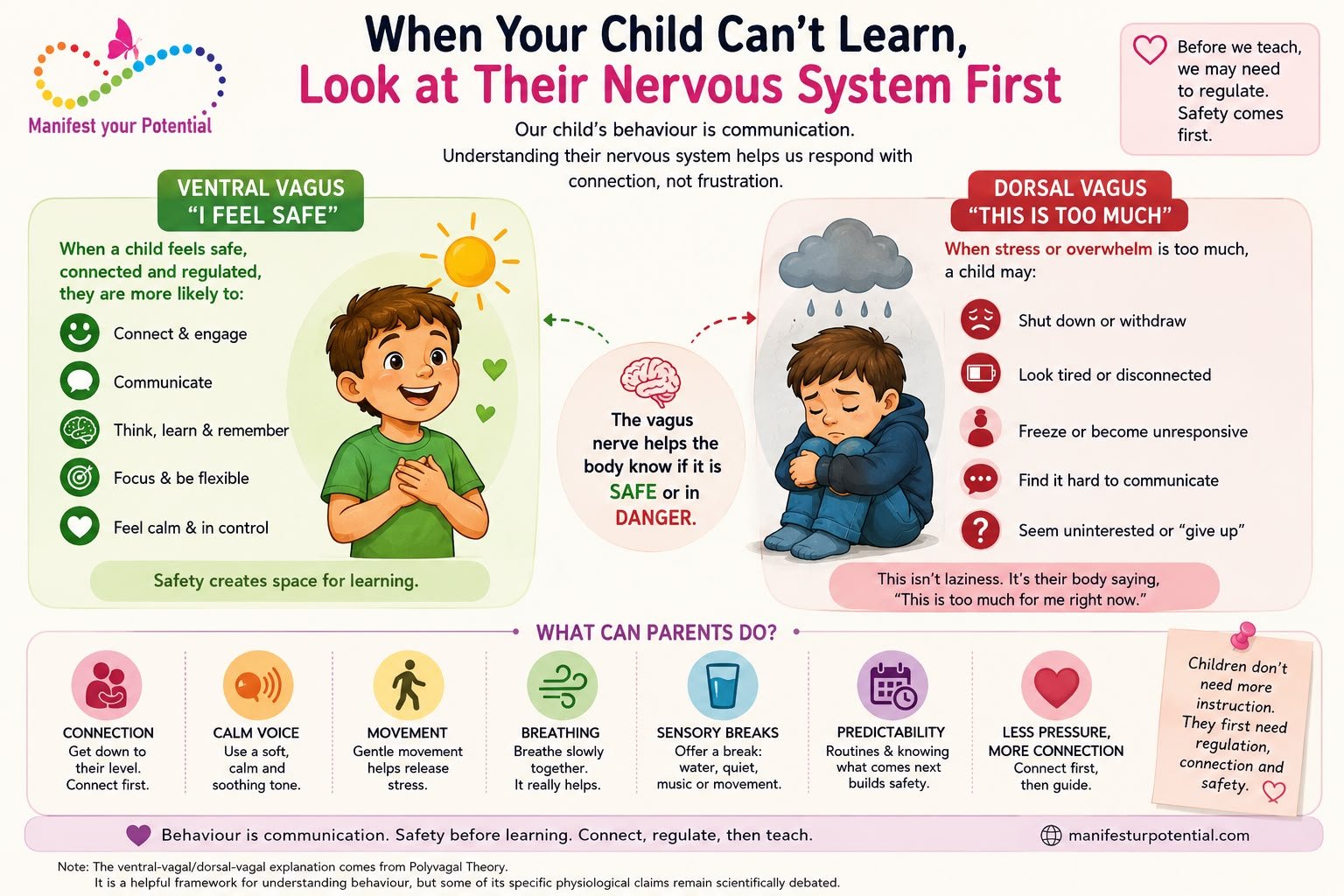
Have you ever wondered why your child can sometimes listen, learn, talk and cooperate beautifully—and at other times seems unable to do even the simplest thing?
As parents, we may quickly think:
“Why is my child not listening?”
“Why is my child behaving like this?”
“Why won’t they try?”
But sometimes the more helpful question is:
“What is happening in my child’s nervous system right now?”
Our nervous system constantly scans our surroundings and our experiences. It helps our body respond to signals of safety, challenge and stress.
One part of this system is the vagus nerve, which plays an important role in regulating many automatic body functions.
The Vagus Nerve: A Simple Way to Understand It
You may have heard the terms ventral vagus and dorsal vagus.
These terms are commonly used in Polyvagal Theory to describe different patterns of nervous-system responses.
A simple way for parents to think about them is:
🟢 Ventral Vagus — “I Feel Safe”
When a child feels safe, connected and regulated, they are more likely to be available for:
* Connecting with others
* Making eye contact and engaging
* Communicating
* Playing
* Exploring
* Paying attention
* Thinking flexibly
* Learning new things
Think about a child who is relaxed with a trusted parent or teacher. They may be curious, playful and willing to try.
Safety creates space for learning.
🔴 Dorsal Vagus — “This Is Too Much”
When stress or overwhelm becomes intense, some children may show a shutdown or withdrawal response.
They may:
* Become very quiet
* Withdraw from people
* Look tired or disconnected
* Stop responding
* Freeze when asked to do something
* Find it difficult to participate
* Seem as though they have “given up”
A parent may interpret this as:
“He’s being lazy.”
“She doesn’t care.”
“He’s refusing to cooperate.”
But sometimes the child’s nervous system may simply be communicating:
> *“This is too much for me right now.”*
This does not mean that every quiet, tired or withdrawn behaviour is a dorsal vagal response. Children can withdraw for many different reasons. The purpose of this framework is to encourage us to look beyond behaviour and consider what the child may be experiencing.
Before We Teach, We May Need to Regulate
Imagine trying to teach a child when they are frightened, overwhelmed or completely shut down.
Giving more instructions may not help.
Repeating:
“Listen!”
“Sit properly!”
“Pay attention!”
“Try harder!”
may actually increase the pressure.
Instead, we can first help the child feel safe, connected and regulated.
Try:
🤗 Connection — get down to the child’s level and connect before giving instructions.
🗣️ A calm voice — our tone can communicate safety.
🚶 Movement — walking, stretching or gentle rhythmic movement may help some children regulate.
🌬️ Slow breathing — breathe slowly together rather than simply telling the child to “calm down.”
🎵 Sensory breaks — music, quiet time, movement or another familiar sensory activity may help.
🧸 Predictability — routines and knowing what comes next can reduce uncertainty.
❤️ Less pressure, more connection — connect first, then guide.
Behaviour Is Communication
One of the most powerful shifts we can make as parents is to stop asking only:
“How do I stop this behaviour?”
and begin asking:
“What might my child’s nervous system be telling me?”
A child who is shouting may be overwhelmed.
A child who is running around may be seeking movement or struggling to regulate.
A child who refuses to participate may be anxious, tired or overloaded.
A child who becomes very quiet may need connection rather than more demands.
This doesn’t mean that every behaviour should be accepted without boundaries.
Children still need boundaries.
But boundaries work best when they are provided alongside connection, safety and regulation.
Safety Before Learning
Learning requires the brain to be available.
When a child feels safe and regulated, they have more opportunity to engage, explore, communicate and learn.
So before asking:
“What should I teach my child?”
perhaps ask:
“Is my child ready to learn?”
And before asking:
“How do I change this behaviour?”
ask:
“What is my child’s nervous system experiencing?”
Sometimes the first step toward better behaviour isn’t more discipline.
It is creating safety.
And sometimes the first step toward learning isn’t another worksheet.
It is helping the child become ready to learn.
────────
A Note for Parents
The ventral-vagal/dorsal-vagal explanation above is based on concepts from Polyvagal Theory. It can be a useful framework for thinking about regulation and behaviour, but some of the theory’s specific physiological claims remain scientifically debated. Children’s behaviour is complex and can have many causes. This framework should therefore be used as a way of asking better questions—not as a diagnostic tool.
Connect first. Regulate next. Teach when ready.