

One of the questions I always wondered was ….
“Why do movement professionals place so much emphasis on integrating the Asymmetrical Tonic Neck Reflex (ATNR) when working on vision?”
The answer lies in one simple concept:
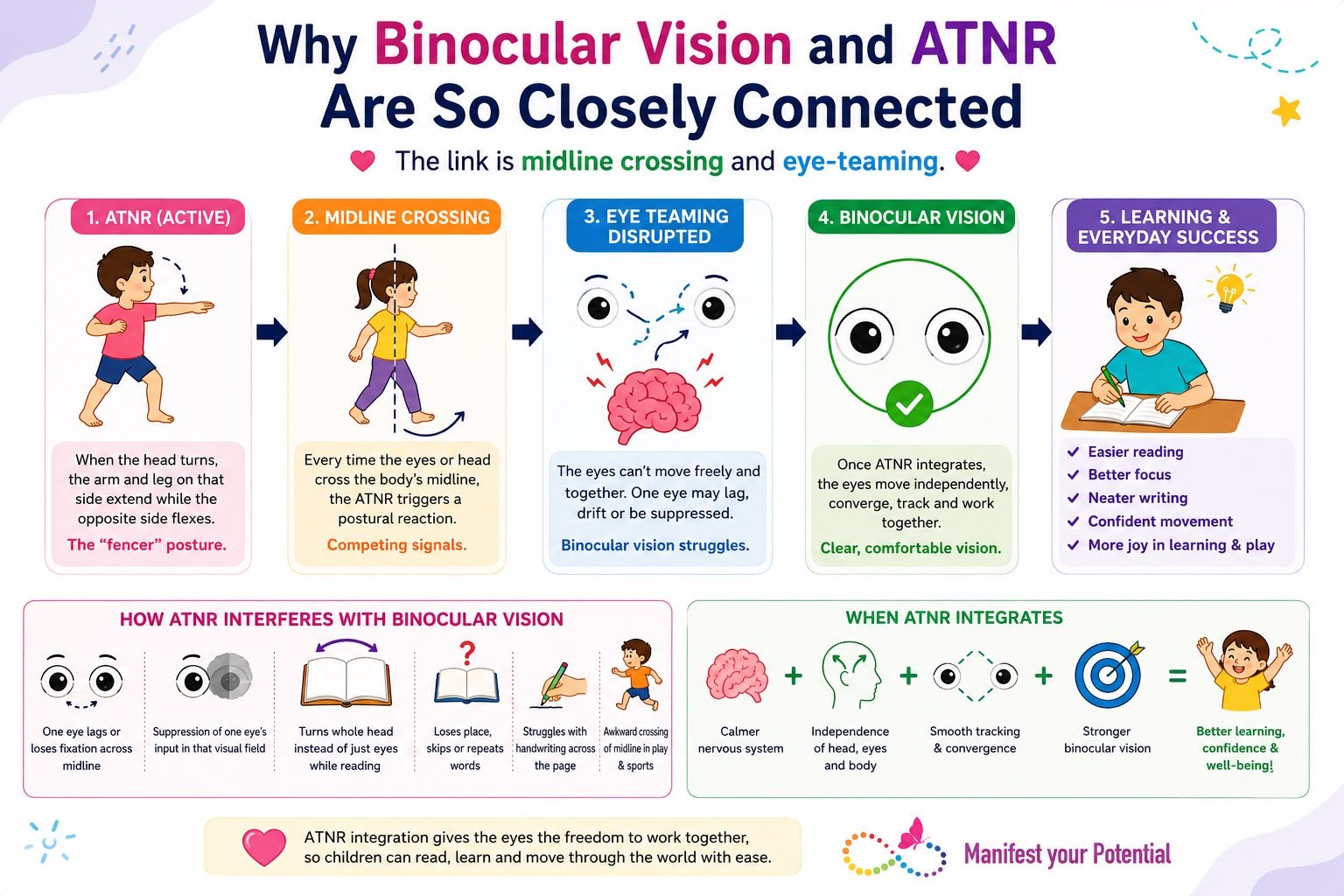
Both binocular vision and the ATNR depend on how well the brain manages movement across the body’s midline.
What is the ATNR?
The Asymmetrical Tonic Neck Reflex (ATNR) is one of the primitive reflexes present from before birth. When an infant turns their head to one side, the arm and leg on the face side naturally extend while the opposite arm and leg bend. This characteristic position is often called the “fencer’s posture.”
In early infancy, this reflex serves important developmental purposes, helping babies discover their hands, develop muscle tone, and prepare for voluntary movement.
As the nervous system matures, the reflex should gradually integrate, allowing the head, eyes, arms, and body to move independently of one another.
Why Does This Matter for Vision?
Good vision is much more than having clear eyesight.
To read comfortably, catch a ball, copy from the board, or move confidently through space, both eyes must work together as a coordinated team. This ability is known as binocular vision.
For binocular vision to develop, the eyes must be able to:
* Move smoothly from left to right.
* Cross the body’s midline effortlessly.
* Converge accurately on near objects.
* Maintain stable focus while the head and body move.
* Fuse the two slightly different images from each eye into one clear picture.
This requires the eyes to move independently of head position.
When ATNR Remains Active
If the ATNR is still influencing movement beyond infancy, turning the head continues to trigger automatic postural responses.
Instead of the eyes moving freely across midline, the entire body wants to follow the head.
Imagine trying to read a sentence from left to right. Every time your gaze crosses the middle of the page, your nervous system is receiving two competing messages:
* The visual system says: “Keep both eyes working together and continue tracking.”
* The ATNR says: “The head has turned—adjust the whole body’s posture.”
These two systems begin to compete with each other.
Rather than allowing smooth eye teaming, the brain has to devote attention to managing the reflex-driven movement.
What Might This Look Like?
A child with an unintegrated ATNR may:
* Turn the entire head instead of moving only the eyes while reading.
* Lose place when reading across a page.
* Skip or repeat words.
* Have one eye drift or lag when tracking across midline.
* Suppress visual information from one eye in certain positions, making binocular fusion more difficult.
* Struggle with handwriting, especially when writing across the page.
* Find crossing the midline awkward during play or sport.
These behaviours are often signs that movement and vision are still influencing one another more than they should.
Eye Teaming Needs Freedom
Think of the eyes as two dancers performing together.
For the dance to be smooth, they need the freedom to move independently while remaining perfectly coordinated.
An active ATNR is like someone repeatedly tugging on one dancer whenever the head turns. The partnership becomes inconsistent—not because the dancers lack ability, but because another force keeps interrupting them.
As the ATNR integrates, the eyes gain greater independence from head movement. This creates the neurological foundation for smoother tracking, better convergence, stronger binocular vision, and more efficient visual processing.
Why Many Movement-Based Approaches Begin with Reflex Integration
Many developmental movement approaches, including Rhythmic Movement Training (RMTi), Brain Gym®, and other movement-based learning programs, recognise that vision does not develop in isolation.
Before expecting a child to improve tracking, convergence, or reading fluency, it is often helpful to address the underlying motor patterns that may still be competing with the visual system.
By reducing the influence of retained primitive reflexes, we allow the visual system to develop on a more stable neurological foundation.
A Final Thought
Vision is not just about the eyes—it is about how the entire nervous system works together.
When the ATNR has integrated, the head can turn, the body can remain stable, the eyes can move smoothly across midline, and both eyes can work together with greater ease.
Sometimes, improving visual skills begins not by exercising the eyes alone, but by helping the brain release an old movement pattern that has simply stayed active longer than it was meant to.
References
Ayres, A. J. (2005). Sensory Integration and the Child.
Goddard Blythe, S. (2005). The Well Balanced Child.
Goddard Blythe, S. (2012). Assessing Neuromotor Readiness for Learning.
Hannaford, C. (2005). Smart Moves: Why Learning Is Not All in Your Head.
Dennison, P. E., & Dennison, G. E. Brain Gym® publications on movement and visual skills.
McPhillips, M., & Sheehy, N. (2004). Primitive reflex persistence, reading difficulties, and developmental coordination.
RMTi (Rhythmic Movement Training International) educational materials on primitive reflex integration.
Note: While retained primitive reflexes have been associated with challenges in posture, movement, and visual efficiency, research is still evolving. Primitive reflex integration should be considered one component of a comprehensive developmental assessment rather than the sole explanation for visual or learning difficulties.