
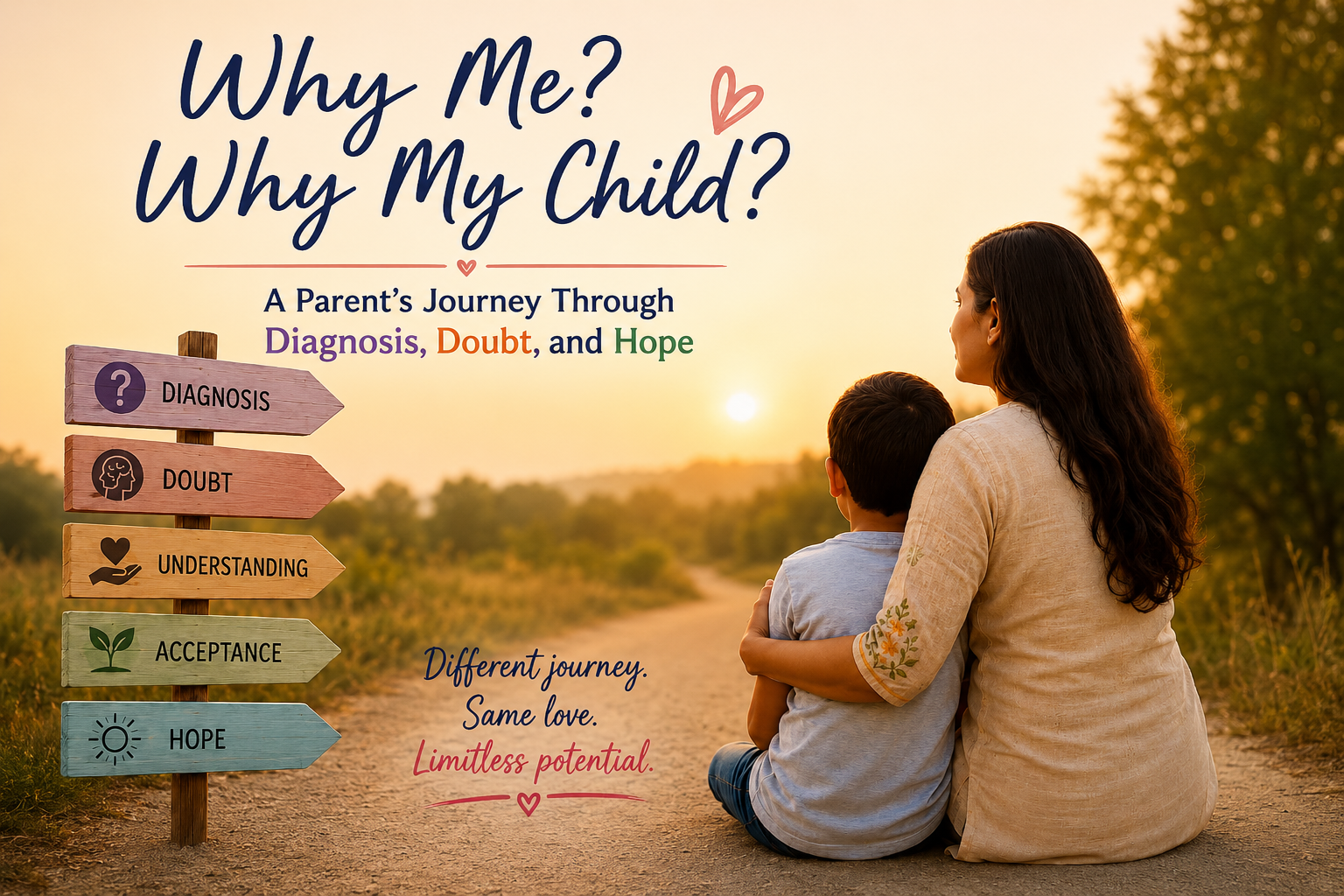
A Parent’s Journey Through Diagnosis, Doubt, and Hope
“What will people say?”
For many Indian parents, that question arrives almost as quickly as the diagnosis itself. Whether your child has autism, ADHD, a learning disability, Down syndrome, cerebral palsy, or another developmental difference, the moment you hear those words, your world changes.
You may find yourself asking:
“Why my child?”
“What did I do wrong?”
“Will my child ever have a normal life?”
These questions don’t come from a lack of love. They come from fear, uncertainty, and the weight of the dreams you held for your child long before they were born.
Every parent imagines a future for their child. We picture them doing well in school, making friends, choosing a career, getting married, and living independently. In India especially, education is often seen as the gateway to success. Marks matter. Entrance exams matter. Achievement matters.
So, when a child struggles to read, write, focus, communicate, or cope in a classroom, it can feel as though the future you imagined is slipping away. But perhaps it is not disappearing. Perhaps it is simply taking a different route.
One of the hardest parts of parenting a child with special needs in India is not just managing the diagnosis—it is managing everyone’s opinions.
“He’ll grow out of it.”
“She’s just lazy.”
“You spoil him too much.”
“In our time, children didn’t have all these problems.”
“Try this treatment.”
“Stop using labels to gain mileage.”
Sometimes these comments come from strangers. More often, they come from people who genuinely love us—family members, relatives, neighbours, and even close friends. They may mean well, but their words can leave parents feeling isolated, guilty, and misunderstood.
The truth is this:
A diagnosis is not the result of poor parenting. And seeking help is not a sign of failure. It is one of the bravest things a parent can do.
For many parents, the biggest challenges begin after the diagnosis. Finding a school that understands. Explaining your child’s needs to teachers. Requesting accommodations without feeling judged. Attending meetings where every difficulty is discussed but every strength is forgotten. Watching your child come home saying, “I’m stupid,” simply because they learn differently.
As parents, we often become advocates overnight. We learn unfamiliar terms. We read reports. We meet therapists. We fight for support. We celebrate tiny improvements that others may never notice. It can be exhausting. But every conversation, every school meeting, and every difficult decision comes from one place—love.
In India, comparisons seem almost unavoidable. Relatives ask about ranks. Neighbours ask about tuition classes. Friends share report cards and achievements. Social media celebrates medals, certificates, and seemingly perfect lives.
Meanwhile, you may be celebrating something entirely different. Your child answered a question in class. They wrote their name independently. They made a friend. They managed a full school day without a meltdown. These victories may seem small to the world. To your family, they are monumental. Every child has a different finish line.
Somewhere along the journey, many parents begin to realise something profound. Their child is so much more than a diagnosis. More than a report. More than an IQ score. More than exam marks.
Our education system often measures children by how quickly they can read, write, calculate, and memorise.
Life asks different questions.
Can they solve problems? Can they show kindness? Can they persevere? Can they find joy? Can they build meaningful relationships?
These qualities are just as valuable, yet they rarely appear on a report card.
Many parents quietly admit something they never expected: their child has changed them.
They have become more patient. More accepting. Less judgmental. They have learned to celebrate effort instead of perfection. They have discovered communities they never knew existed. They have met teachers, therapists, and other parents whose compassion has restored their faith in humanity.
Their child may learn differently. But they also teach differently.
If your child’s diagnosis is recent, you may still be grieving. That is okay.
If you feel angry, confused, or frightened about the future, that is okay too. You do not have to pretend to be strong every day.
But don’t let fear become the loudest voice in your parenting.
Your child is listening. They are watching how you see them. If you believe they are broken, they may begin to believe it too. If you believe they are capable—even if the journey is slower—they will borrow your hope until they find their own.
Let’s Change the Question
Instead of asking, “Why my child?”, what if we asked, “What does my child need to flourish?”
Instead of asking, “How can I make my child fit into the system?”, what if we asked, “How can the system become flexible enough to include every child?”
And instead of asking, “What will people say?”, what if we began asking, “What does my child need from me today?”
That one question has the power to silence every other voice.
Every Child Deserves to Belong
Our children do not need pity. They do not need to be “fixed” to deserve acceptance. They need understanding. They need opportunities. They need schools that recognise their strengths, not just their struggles. They need communities that choose inclusion over judgment.
Most of all, they need parents who see beyond the diagnosis and recognise the remarkable child standing before them.
The journey may not look like the one you imagined.
It may be slower. It may be harder. It may ask more of you than you ever thought possible.
But it can also be filled with unexpected joy, extraordinary resilience, and a deeper understanding of what truly matters.
One day, you may look back and realise that the question, “Why my child?” slowly transformed into something far more powerful:
“Thank you for teaching me to see the world differently.”
And perhaps, that is the greatest gift of all.