

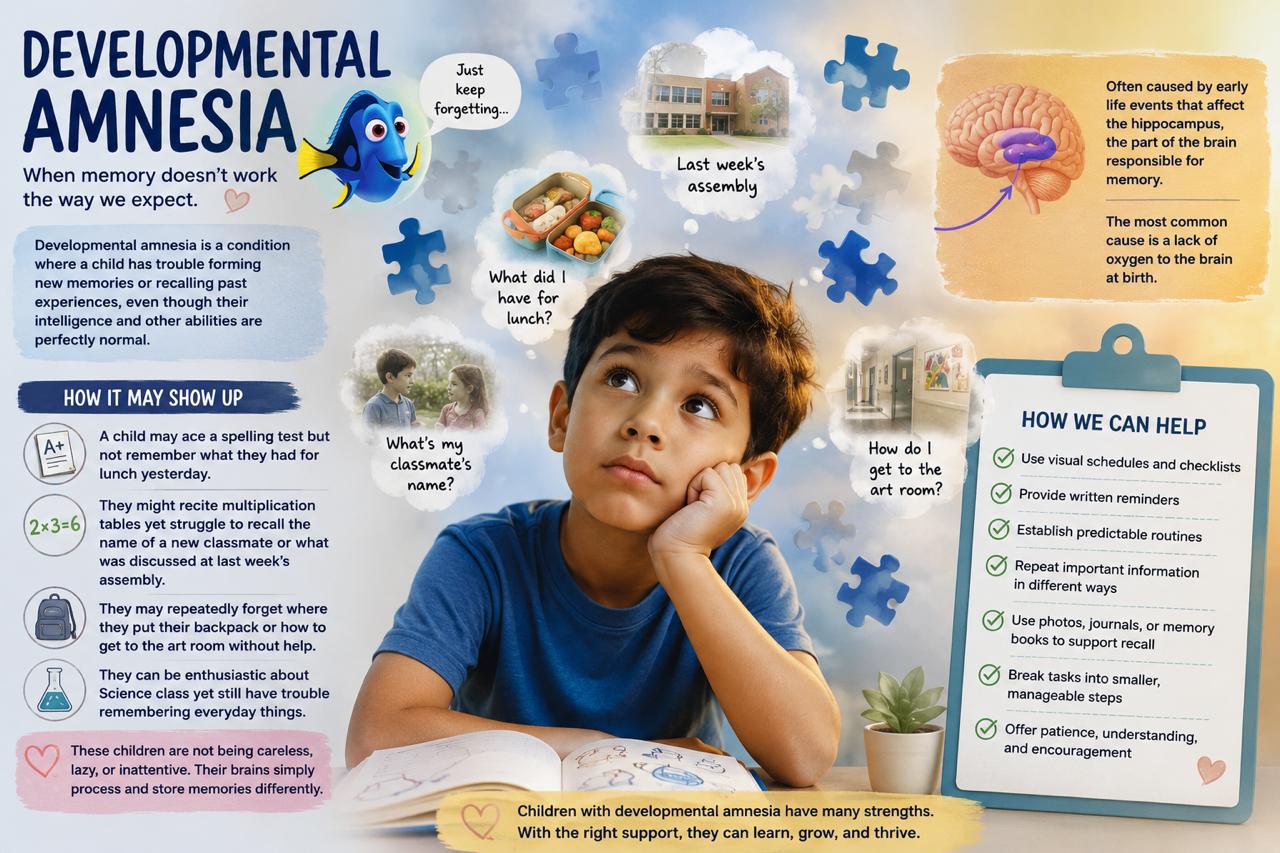
Have you ever wondered why some children seem to forget things more often than others, just like Dory in Finding Nemo? Developmental amnesia is a condition where a child has trouble forming new memories or recalling past experiences, even though their intelligence and other abilities are perfectly normal. While the term might sound daunting, it simply means that the brain’s memory system hasn’t developed as expected, often due to early-life events affecting the hippocampus, the part of the brain responsible for memory. This is most often caused by a lack of oxygen reaching the brain at birth.
For school-going children, developmental amnesia can show up in some surprising ways. For example, a child might ace their spelling test but not remember what they had for lunch yesterday. Another student might be able to recite multiplication tables yet struggle to recall the name of a new classmate or what was discussed at last week’s assembly. You might find a child who is enthusiastic about Science class but repeatedly forgets where they put their backpack or how to get to the art room without help.
Based on her observations, Vargha-Khadem, a consultant neuropsychologist at Great Ormond Street Hospital in London, outlined three main characteristics of developmental amnesia. First, spatial memory problems, such as getting lost in familiar surroundings or forgetting where they’d left their belongings. Second, temporal memory problems, including needing frequent reminders for regularly scheduled classes or activities. And third, episodic memory problems or being unable to remember events in their lives.
Practical Strategies for Home and School
• Visual Supports: Use charts, colour-coded folders, and labels for supplies and classroom areas. A daily schedule with pictures can help children know what to expect.
• Checklists and Routines: Encourage children to use a checklist for their school bag or morning routine. Predictable routines reduce the burden on memory and help kids feel secure.
• Repetition and Review: Revisit important concepts and experiences regularly. For example, if a field trip is coming up, discuss it several times beforehand and review what happened after returning.
• Storytelling and Journaling: Help children keep a simple diary or use drawings to record daily events. At school, a “memory buddy” system can pair kids up to chat about what happened that day.
• Chunking Information: Teach children to break larger tasks or information into smaller parts. For example, instead of memorizing a whole poem at once, focus on one stanza a day.
• Verbal Prompts and Cues: Gently remind children about people, places, or events by using clues (“Do you remember who sits next to you in math class?”).
• Celebrate Strengths: Focus on what children do well, whether it’s solving puzzles, drawing, or telling jokes. Confidence can help balance the frustrations of forgetfulness.
Memory is just one piece of the learning puzzle—and with the right support, every child can succeed. Together, we can ensure that all children, regardless of their memory challenges, feel valued, understood, and supported.
Preeti is an M.Sc. in Developmental Biology and has dual B.Eds in Science and Special Education (Learning Disabilities). She is a dedicated RCI-registered Special Educator and the founder of her own remediation centre, NurtureNest. A licensed Brain Gym Instructor, she integrates Brain Gym, Movement-Based Learning, and Reflex Management into her practice to create dynamic and effective learning experiences for her students.