
In Brain Gym®, simple movements are often used to explain how the brain and body work together. One powerful symbol that appears throughout Brain Gym is the letter X.
At first glance, it may seem like just a shape. Yet the X carries a profound message about connection, integration, and the way our brains and bodies are designed to work together.
The X is Everywhere
If we look closely at nature, we find the X pattern in many places.
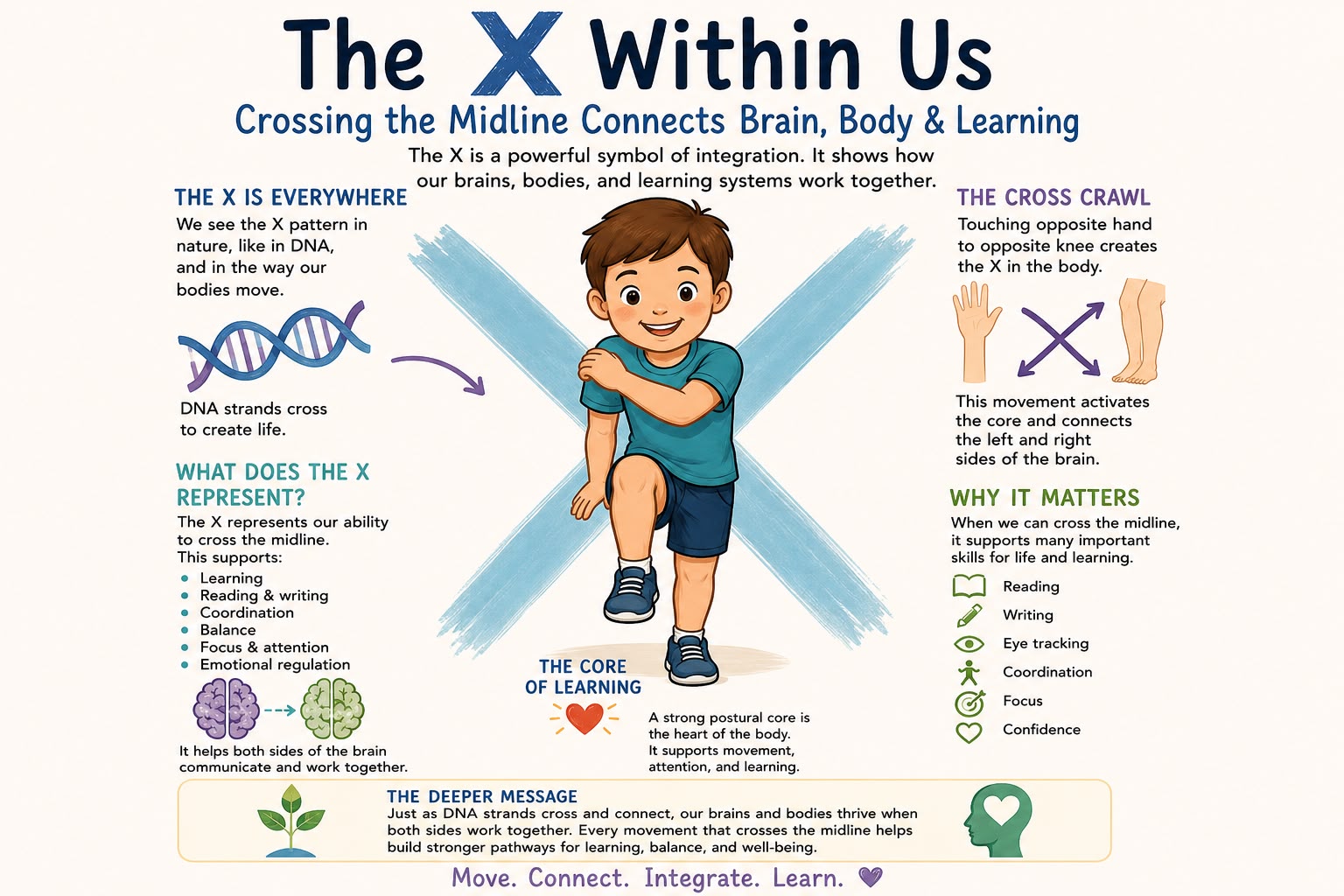
One fascinating example is DNA, the blueprint of life. The strands of DNA cross over each other, forming an X-like pattern. This crossing symbolizes communication, connection, and the sharing of information.
The human body also creates an X pattern naturally.
When we walk, our right arm swings forward with our left leg, and our left arm swings forward with our right leg. Every step we take forms an invisible X through the body.
This crossing movement is not accidental. It is part of the body’s natural design for efficient movement and brain integration.
What Does the X Represent?
The X represents our ability to cross the midline.
The midline is an imaginary line that divides the body into right and left halves.
Whenever we reach across our body, crawl, walk, dance, or perform movements that cross this line, both sides of the brain are required to communicate and work together.
This integration supports:
* Learning
* Reading and writing
* Coordination
* Balance
* Focus and attention
* Emotional regulation
* Problem-solving
Crossing the midline helps the brain function as a whole rather than as separate parts.
The Cross Crawl Connection
One of the best-known Brain Gym activities is the Cross Crawl.
In this movement:
* The right hand touches the left knee.
* The left hand touches the right knee.
This simple action creates the X pattern in the body.
The movement encourages communication between the left and right hemispheres of the brain while activating the body’s core muscles.
When the X is Missing
Some children and adults find crossing the midline challenging.
They may avoid reaching across the body, move only one side, or compensate by twisting awkwardly.
When crossing the midline is difficult, people may experience challenges with:
* Reading across a page
* Eye tracking
* Handwriting
* Coordination
* Balance
* Organizing thoughts
These challenges simply suggest that the brain and body may benefit from more opportunities for integration through movement.
The Core of the Body, the Core of Learning
Paul Dennison, co-founder of Brain Gym, often emphasized:
“The postural core is the heart of the body.”
A strong and integrated core supports movement, balance, attention, and learning.
When we perform movements that create the X pattern, we engage not only our muscles but also the communication pathways that help the brain organize information more effectively.
Bringing the X into Everyday Life
The wonderful thing about the X is that it can be explored in simple and playful ways.
Making an X on the Body
Parents can gently trace an X on their child’s back using their finger. Many children find this calming and organizing.
Children can also make an X on their own bodies by:
* Touching opposite shoulders
* Touching opposite hips
* Crossing their hands over their chest
* Reaching across to opposite knees or feet
* Drawing an X from the shoulder to the hip with their hands
These activities help develop body awareness and encourage crossing the midline.
Drawing and Seeing the X
The X can also be experienced visually.
Children can:
* Draw large Xs on paper
* Trace Xs in sand or shaving foam
* Make Xs in the air
* Walk along X-shaped pathways
* Follow X patterns with their eyes
These activities help connect visual, motor, and cognitive skills.
Cross-Lateral Activities
Many everyday movements naturally create the X pattern:
* Cross Crawl
* Crawling games
* Marching while touching opposite knees
* Dancing
* Throwing and catching across the body
* Climbing activities
Each of these movements encourages greater communication between both sides of the brain.
My Personal Experience with the X
Over the years, I have developed a personal connection with the X.
Whenever I find myself losing track of my thoughts or feeling mentally scattered, I close my eyes and visualize a large X.
Almost immediately, I feel more organized, more centered, and able to return to what I was thinking about.
Whether it is the symbolism of integration or the act of focusing my attention, the X has become a simple tool that helps me regain clarity.
A Story About Balance
I remember an experience with my aunt that deepened my appreciation for this symbol.
She had begun losing her balance and relied heavily on a cane while walking.
One day, I placed a large X on a wall and asked her to keep her eyes focused on it while she walked across the room.
To my surprise, she walked the entire length of the room in a straight line without her cane.
This experience reminded me of the close relationship between vision, attention, posture, and movement. Sometimes the brain organizes movement more effectively when it has a clear visual target to focus on.
While this is a personal observation rather than scientific proof, it was a powerful reminder of how something as simple as an X can influence awareness and movement.
Why This Matters for Children
For children, crossing the midline is much more than a physical skill.
It supports:
✔️ Reading fluency
✔️ Handwriting
✔️ Bilateral coordination
✔️ Eye tracking
✔️ Attention and concentration
✔️ Emotional regulation
✔️ Confidence in learning
Through playful movement experiences, children build the neural pathways that support learning and development.
The Deeper Message of the X
The X is much more than a letter.
It is a symbol of connection.
It represents the meeting point of left and right, body and brain, movement and learning.
Just as the strands of DNA cross and communicate, our brains and bodies thrive when different parts work together in harmony.
The next time you draw an X, trace an X on a child’s back, perform a Cross Crawl, or simply visualize an X in your mind, remember that you are engaging with one of nature’s most powerful patterns—a pattern that reminds us that growth happens when connections are made.
Perhaps that is why such a simple shape can have such a profound effect.
The X is not just a symbol.
It is a reminder that integration is at the heart of learning, balance, and well-being.
Reference
Kuhs, G. A. (2010). The Metaphor of the X, Part 1. Brain Gym Global Observer, May 2010, pp. 6–7.
Personal experiences described in this article are anecdotal observations and are shared for educational purposes. They are not intended as medical advice or scientific evidence.
Minaz Ajani has an M.Ed (Sp.Ed) LD, and is an accomplished Educator and International Faculty member of Breakthroughs International, Home of the Brain Gym® program. She is a licensed Brain Gym® ,Touch for Health®, RMTi and Movement-Based Learning instructor.