
Have you ever had a conversation that suddenly turned into an argument?
Or felt that no matter what you said, the other person just wasn’t listening?
Often, the problem isn’t the words being used. The problem is the state of the brain.
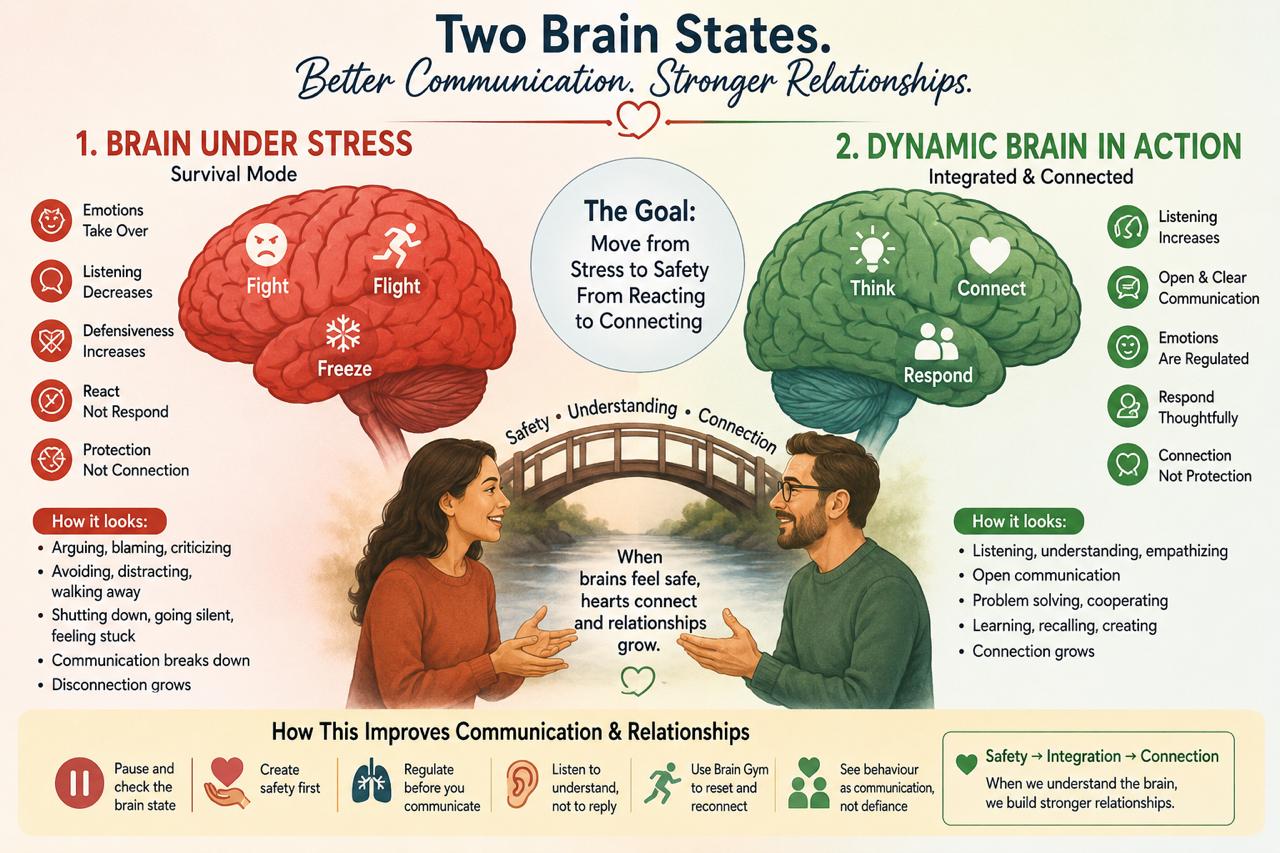
The diagram of The Brain Under Stress and The Dynamic Brain in Action helps us understand why communication sometimes breaks down and how we can create healthier, more meaningful relationships.
State 1: The Brain Under Stress
When a person feels threatened, judged, overwhelmed, misunderstood, or emotionally unsafe, the brain shifts into a survival state.
In this state:
* The thinking brain becomes less accessible.
* Emotions take over.
* Listening decreases.
* Defensiveness increases.
* People react rather than respond.
This may look like:
Fight
* Arguing
* Criticizing
* Blaming
* Becoming aggressive
Flight
* Avoiding conversations
* Changing the subject
* Walking away
* Becoming distracted
Freeze
* Going silent
* Withdrawing
* Feeling stuck
* Not knowing what to say
At this moment, communication becomes difficult because the brain is focused on protection rather than connection.
State 2: The Dynamic Brain in Action
When a person feels safe, respected, and understood, the whole brain works together.
In this state, people are more likely to:
* Listen openly
* Think clearly
* Express feelings appropriately
* Solve problems
* Show empathy
* Cooperate with others
* Learn from experiences
Instead of reacting automatically, they can respond thoughtfully.
This is the state where healthy communication and meaningful relationships thrive.
Why This Matters in Relationships
Whether we are talking to a spouse, child, colleague, friend, or student, communication improves when both people are operating from an integrated brain state.
People don’t connect well when they feel:
* Criticized
* Ignored
* Controlled
* Judged
* Rushed
* Unsafe
People connect better when they feel:
* Heard
* Seen
* Valued
* Respected
* Safe
Connection is a biological need, not just an emotional one.
Using This Knowledge in Everyday Life
1. Notice the Brain State Before Continuing the Conversation
Instead of asking:
“Why are they behaving like this?”
Ask:
“Are they stressed right now?”
A stressed brain cannot communicate effectively.
Sometimes the best response is not to talk more.
It is creating safety first.
2. Regulate Before You Communicate
When emotions are high:
* Pause
* Breathe
* Drink water
* Take a short walk
* Do Brain Gym activities
* Cross the midline
* Use Positive Points
* Practice Hook-Ups
A regulated brain communicates better than a reactive brain.
3. Listen to Understand, Not to Reply
When the brain feels safe, it becomes receptive.
Try:
* Maintaining eye contact
* Listening without interrupting
* Reflecting what you heard
* Showing curiosity instead of judgment
People calm down when they feel understood.
4. Use Brain Gym to Support Connection
Brain Gym reminds us that movement can help integrate the brain.
Simple activities such as:
* Cross Crawl
* Lazy 8s
* Hook-Ups
* Positive Points
* Deep breathing
can help move a person from stress toward a more integrated state where communication becomes easier.
5. Remember That Behaviour Is Communication
A child melting down.
A partner becoming defensive.
A colleague shutting down.
These behaviours often signal stress rather than unwillingness.
When we see behaviour as communication, we respond with curiosity instead of criticism.
The Relationship Formula
When people feel threatened:
Stress → Protection → Disconnection
When people feel safe:
Safety → Integration → Connection
A Brain Gym Perspective
Brain Gym teaches us that learning, communication, and relationships all depend on integration.
The more integrated the brain and body are, the easier it becomes to:
* communicate clearly,
* understand others,
* manage emotions,
* solve problems,
* and build meaningful relationships.
Before trying to change someone’s behaviour, help them move from a stressed brain to a dynamic brain.
Because people learn best, communicate best, and connect best when they feel safe.
Final Thought
“Connection happens when brains feel safe enough to be receptive and hearts feel open enough to relate.”
When we understand the difference between a stressed brain and a dynamic brain, we gain a powerful tool for improving every relationship in our lives.
————————————————————————————————————————————————————————————————————————–
Reference: The concept of The Brain under stress and The Dynamic brain is taught is Brain Gym®101: Balance for Daily Life by Paul E Dennison & Gail E Dennison.
Minaz Ajani -M.Ed (Sp. Ed) LD., is an accomplished Educator and International Faculty member of Breakthroughs International, Home of the Brain Gym® program. She is a licensed Brain Gym®, Touch for Health®, RMTi and Movement-Based Learning instructor and consultant.