

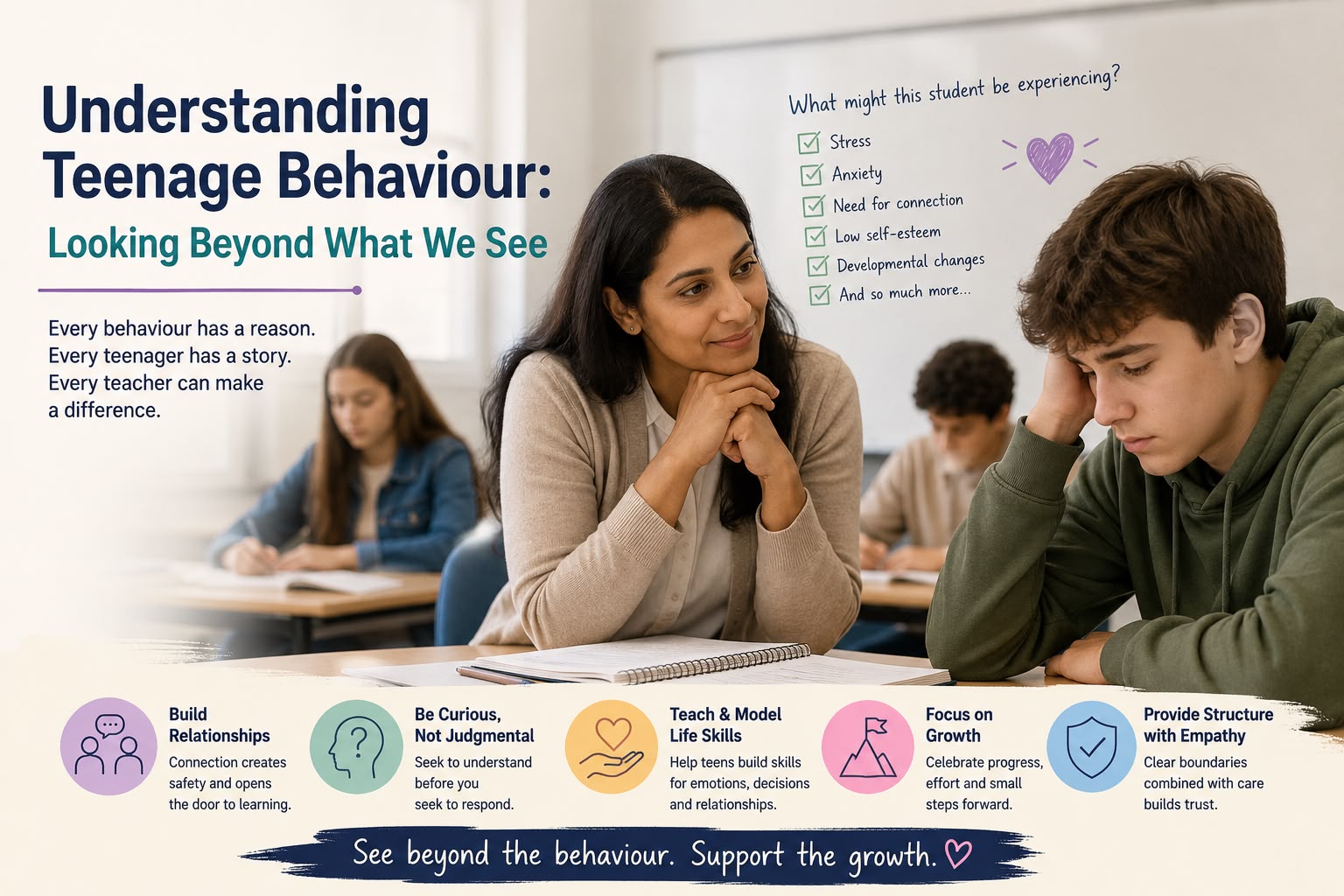
Many teachers find the teenage years challenging. One day, a student is enthusiastic and cooperative, and the next day they seem argumentative, withdrawn, or completely disengaged. It is easy to label these behaviours as laziness, defiance, or lack of discipline. However, teenage behaviour often reflects important developmental changes taking place in the brain, body, and social world.
Adolescence is a period of rapid growth. Teenagers are learning to become independent, manage emotions, make decisions, build relationships, and discover who they are. During this process, behaviours such as aggression, withdrawal, poor decision-making, people-pleasing, or lack of motivation may emerge.
As educators, our role extends beyond managing behaviour. When we understand what may be driving a student’s actions, we can respond in ways that support growth, resilience, and learning.
Understanding What Lies Beneath the Behaviour
Behaviour is often a form of communication. Teenagers may not always have the words, emotional awareness, or confidence to express what they are experiencing. As a result, their struggles often show up through their actions.
For example:
* The aggressive student may be feeling overwhelmed, anxious, or powerless.
* The withdrawn student may be afraid of making mistakes or being judged.
* The student who appears lazy may actually be struggling with motivation, stress, executive functioning, or low self-esteem.
* The teenager who constantly follows others may be seeking acceptance and belonging.
* The impulsive student may still be developing the skills needed for planning and decision-making.
When teachers look beyond the behaviour, they gain valuable insights into how best to support the student.
Common Teenage Behaviours and What They May Mean
1. Poor Decision-Making
Teachers often wonder why intelligent students make choices that seem irrational.
Examples:
* Not studying for an important test.
* Following peers into inappropriate behaviour.
* Ignoring consequences despite repeated warnings.
The teenage brain is still developing, particularly the areas responsible for planning, judgment, and impulse control. At the same time, the emotional centres of the brain are highly active, making teens more sensitive to rewards, excitement, and peer approval.
What helps:
* Discuss consequences before situations arise.
* Encourage students to think through different options.
* Use reflective questions such as, “What might happen if…?” and “What could you do differently next time?”
* Teach decision-making as a skill rather than expecting it to develop automatically.
2. Aggressive Behaviour
Aggression can take many forms, including arguing, talking back, bullying, sarcasm, or physical confrontations.
Often, aggression is a sign that a student feels threatened, frustrated, embarrassed, or unable to cope.
What helps:
* Stay calm and avoid power struggles.
* Address behaviour privately whenever possible.
* Acknowledge feelings while maintaining clear boundaries.
* Teach emotional regulation strategies.
* Help students identify alternative ways to express frustration.
Remember: a calm adult can help regulate a dysregulated teenager.
3. Timid or Withdrawn Behaviour
Some students rarely participate, avoid eye contact, or hesitate to ask for help.
Teachers may mistakenly assume these students are uninterested or lack confidence.
Possible reasons include:
* Fear of failure
* Social anxiety
* Previous negative experiences
* Perfectionism
What helps:
* Create a classroom where mistakes are viewed as part of learning.
* Allow students to share ideas in pairs before speaking to the whole class.
* Recognize effort and progress.
* Build trust through positive interactions.
Sometimes the quietest students have valuable insights but need a safe environment to share them.
4. Submissive or People-Pleasing Behaviour
These students often agree with everyone, avoid conflict, and struggle to express their own opinions.
Examples:
* Letting others make decisions during group work.
* Agreeing even when they disagree.
* Taking responsibility for others’ mistakes.
What helps:
* Encourage independent thinking.
* Ask for their opinion directly.
* Validate their ideas and contributions.
* Teach assertive communication skills.
Developing a healthy voice is an important part of adolescence.
5. Lack of Motivation
One of the most common concerns teachers report is, “This student has so much potential but just doesn’t seem motivated.”
However, motivation is influenced by many factors, including:
* Stress
* Sleep deprivation
* Anxiety
* Learning difficulties
* Lack of confidence
* Feeling disconnected from learning
What helps:
* Break large tasks into manageable steps.
* Provide opportunities for success.
* Connect learning to real-life interests.
* Focus on growth and improvement rather than only grades.
* Build positive relationships with students.
Students are more likely to engage when they feel capable, connected, and understood.
What Every Teacher Can Do
While teachers cannot solve every challenge a teenager faces, they can create an environment that supports healthy development.
Build Relationships First
Students learn best from adults who genuinely care about them. A brief conversation, a warm greeting, or noticing a student’s strengths can have a lasting impact.
Be Curious Rather Than Judgmental
Instead of asking:
“What’s wrong with this student?”
Try asking:
“What might this student be experiencing?”
This simple shift often changes the way we respond.
Teach Emotional and Social Skills
Just as we teach academic skills, students also need guidance in:
* Problem-solving
* Decision-making
* Emotional regulation
* Communication
* Conflict resolution
These skills are learned through practice and modelling.
Model the Behaviour You Want to See
Teenagers are constantly observing adults.
When teachers demonstrate:
* Respect
* Calmness under pressure
* Flexibility
* Empathy
* Accountability
Students learn valuable life skills through observation.
Remember That Growth Takes Time
Adolescence is a journey, not a destination. Mistakes, emotional ups and downs, and occasional poor choices are a normal part of growing up.
Our goal as educators is not to eliminate every challenging behaviour but to guide students toward greater self-awareness, responsibility, and resilience.
Final Thoughts
Behind every behaviour is a young person trying to navigate the complex journey from childhood to adulthood. When teachers look beyond the surface and seek to understand the needs underneath the behaviour, they create opportunities for connection, growth, and learning.
The teenager who appears difficult today may simply need an adult who sees beyond the behaviour and believes in their potential.
Minaz Ajani has a Master’s in Special Education with a focus on Learning Disabilities, a Postgraduate Diploma in Counselling Psychology, International Licensed Brain Gym ®️, Touch For Health, Movement-Based Learning and RMti Instructor and Consultant