
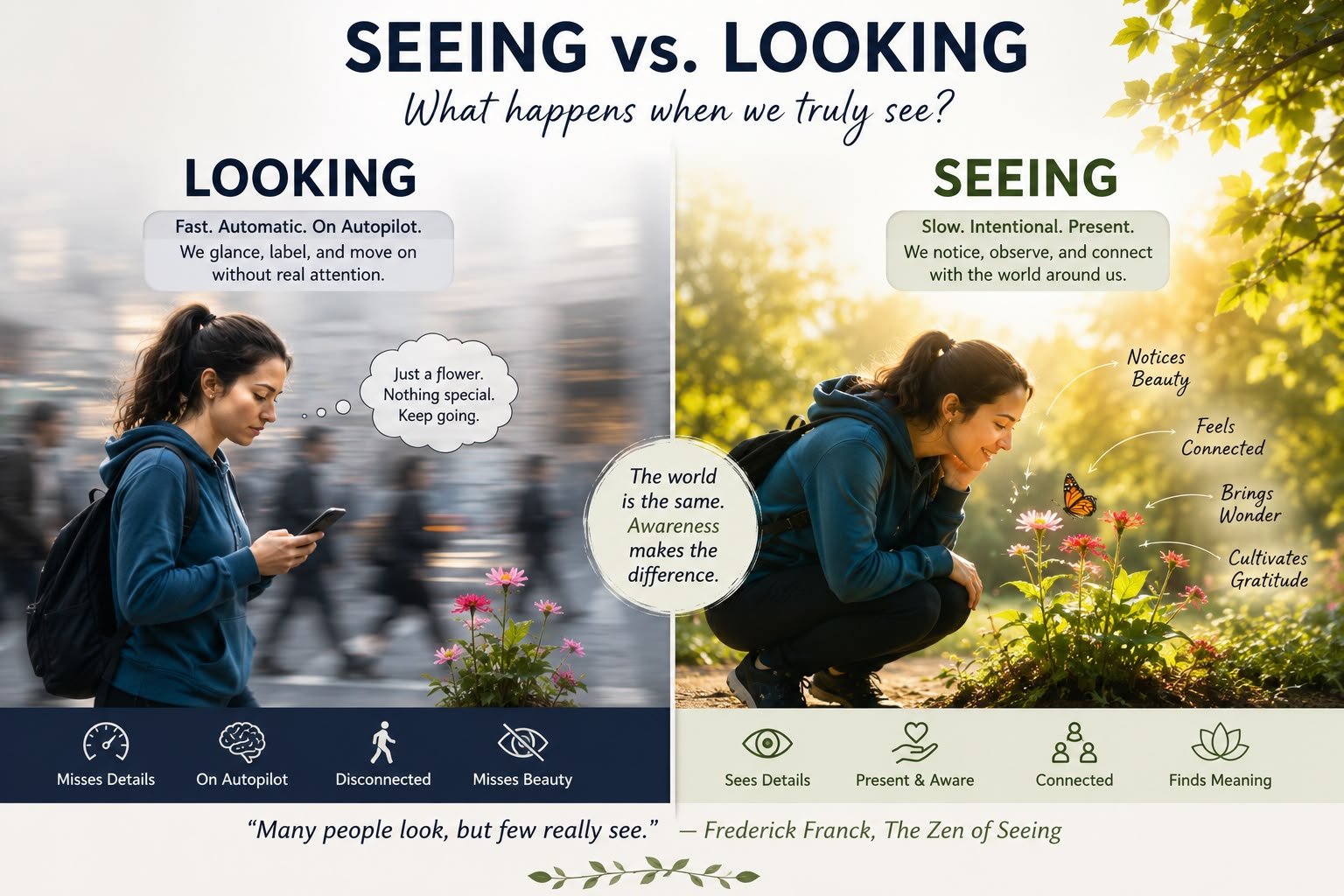
“Many people look, but few really see.”
— Inspired by The Zen of Seeing by Frederick Franck
Every day our eyes are open for nearly sixteen hours. We look at thousands of faces, objects, screens, and landscapes. We glance at traffic lights, read messages, watch television, and scroll endlessly through social media.
Yet how much of it do we truly see?
In his beautiful book The Zen of Seeing, Frederick Franck reminds us that there is a profound difference between looking and seeing. Looking happens automatically. Seeing is an act of awareness.
Looking is Automatic. Seeing is Intentional.
Looking requires only functioning eyes.
Seeing requires your attention, curiosity, and presence.
When we merely look, our brain quickly labels things.
* Tree.
* Child.
* Flower.
* Teacher.
* Parent.
Once something has a label, the brain often stops paying attention. It believes it already knows what it is.
Seeing asks us to pause.
Instead of asking, “What is this?” we begin asking,
“What do I notice?”
Suddenly we see the tiny veins on a leaf, the changing shades of green, the tension in a child’s shoulders, or the sparkle in someone’s eyes when they feel understood.
The object hasn’t changed.
Our awareness has.
Why Our Brain Stops Seeing
Our brains are designed for efficiency.
The nervous system constantly filters information to protect us from overload. It predicts what it expects to find rather than processing every detail anew.
This is why we sometimes:
* drive home without remembering the journey,
* read a page without absorbing it,
* listen without hearing,
* or look directly at someone without noticing how they are feeling.
We aren’t careless.
Our brains have switched to autopilot.
Autopilot is useful for routine tasks.
But growth, learning, creativity, empathy, and joy happen when we step out of it.
Seeing Changes the Brain
When we intentionally observe details, we activate networks involved in attention, visual perception, curiosity, and memory.
Children who learn to observe often become better problem solvers.
Artists develop this skill through drawing.
Scientists develop it through careful observation.
Therapists develop it by noticing subtle body language.
Parents develop it by recognising tiny emotional shifts before behaviour becomes challenging.
Seeing is not just about vision.
It is about connection.
Seeing Through a Child’s Eyes
Young children naturally see.
They stop to watch ants carrying food.
They notice shapes in clouds.
They become fascinated by shadows.
They stare at bubbles floating through the air.
Adults often hurry them along.
“Come on.”
“We’re late.”
“Don’t waste time.”
Yet those moments of wonder are not wasted.
They are building attention, curiosity, visual discrimination, imagination, and emotional regulation.
Play invites children to see.
Screens often encourage passive looking.
Looking at Behaviour vs. Seeing the Child
As educators and parents, we often look at behaviour.
We see:
* a child who won’t sit still,
* one who avoids eye contact,
* one who struggles with reading,
* one who appears lazy,
* one who seems distracted.
But seeing asks different questions.
What is this child communicating?
What sensory experiences are they having?
What movement patterns are missing?
Could vision, primitive reflexes, emotional safety, or stress be influencing what I observe?
Seeing allows compassion to replace judgement.
Practising the Art of Seeing
Like any skill, seeing becomes stronger with practice.
Try these simple exercises:
* Spend one minute looking at a leaf. Notice ten things you’ve never noticed before.
* Watch someone speak without interrupting. Observe facial expressions, breathing, posture, and gestures.
* During a walk, notice five colours you hadn’t consciously seen before.
* Look at a familiar room as though you have never entered it.
* Draw an everyday object—not to create art, but to discover how much you normally overlook.
These activities slow the brain just enough for deeper perception to emerge.
Seeing in Brain Gym® and Movement
Movement-based learning reminds us that attention is not just a mental process—it is a whole-body experience.
When children develop visual tracking, peripheral awareness, balance, and the ability to cross the midline, they become better able to engage with the world around them.
They don’t simply look at words on a page.
They begin to see patterns.
They don’t simply watch another person.
They begin to understand emotions.
Seeing grows alongside movement, attention, and presence.
The Gift of Truly Seeing
Perhaps the greatest gift we can offer another person is not advice.
Not solutions.
Not even encouragement.
It is to truly see them.
To notice.
To be present.
To say, without words,
“I see you.”
Frederick Franck reminds us that seeing is not merely a visual act—it is a way of living.
In a world filled with distractions, notifications, and constant motion, perhaps the greatest mindfulness practice is simply to slow down long enough to really see.
Because when we change the way we see the world, the world quietly changes the way it appears to us.
⸻
References
Franck, F. (1973). The Zen of Seeing: Seeing/Drawing as Meditation. Vintage Books.
Dennison, P. E., & Dennison, G. E. Various works on Brain Gym® and Vision Circles.
Research in cognitive neuroscience on attention, perception, predictive processing, and mindfulness supports the distinction between automatic visual processing and mindful observation.