

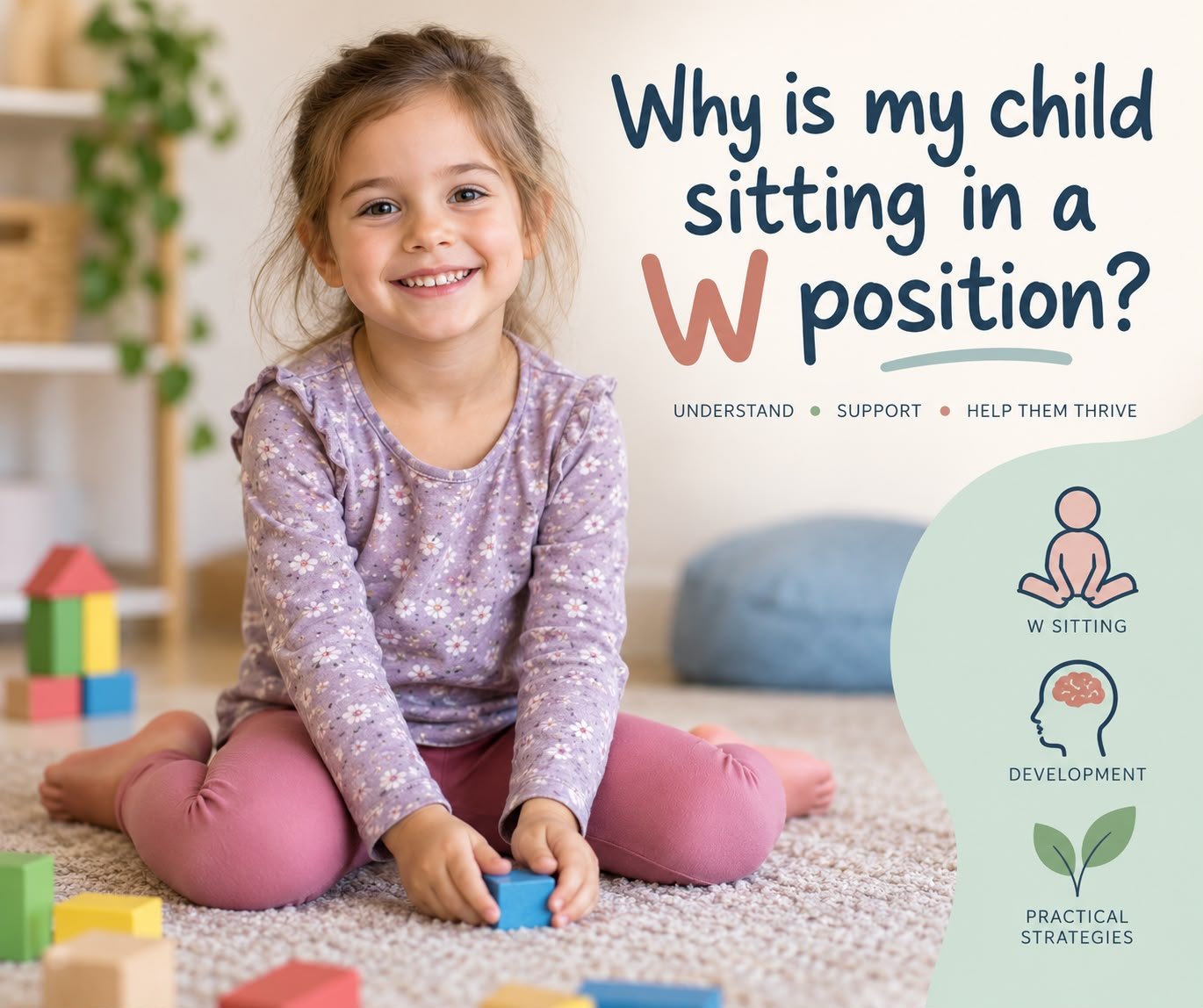
“My child always sits with their legs in a W shape. I’ve heard that W-sitting is not good. Should I be worried?”
This is a question many parents and teachers ask.
W-sitting is when a child sits on the floor with their knees bent and their feet positioned outside their hips, creating a shape that looks like the letter W.
You may notice children using this position during play, while watching television, reading, or doing activities on the floor.
Why do children choose this position?
W-sitting can feel very stable.
It gives children a broad base of support and allows them to sit upright without using as much of their trunk and abdominal muscles to maintain balance. For some children, particularly those who find postural control challenging, this position may feel easier.
Occasional W-sitting is not automatically a sign that something is wrong.
However, if a child consistently prefers W-sitting and also has difficulties with posture, balance, coordination or movement, it may be worth looking at the bigger picture.
Could primitive reflexes be part of the picture?
One reflex that is sometimes considered when looking at postural and coordination difficulties is the Symmetrical Tonic Neck Reflex (STNR).
The STNR is a developmental reflex that helps coordinate movements between the upper and lower parts of the body as babies develop. As the child matures, this reflex is normally inhibited so that more mature patterns of movement and postural control can develop.
When looking at STNR-related movement patterns, practitioners may observe how the child coordinates:
Head movement → spine → arms → legs
For example, bending the head forward is associated with bending of the arms and straightening of the legs, while extending the head is associated with straightening the arms and bending the legs.
This coordination becomes important for activities such as crawling, sitting, reaching and later classroom and sporting skills.
Importantly, W-sitting alone cannot tell us that the STNR is unintegrated. It is the child’s overall movement pattern that provides a more meaningful picture.
What might you notice when postural control and STNR-related movement patterns are immature?
Depending on the child, you may notice:
* Poor or inconsistent posture
* A tendency to slump at a desk or table
* Difficulty maintaining a seated position for extended periods
* Frequent changing of position while working
* Clumsiness or reduced body coordination
* Difficulty catching or throwing a ball
* Challenges with hand-eye coordination
* Difficulty coordinating the upper and lower body during movement
* Messy or inefficient eating movements
* Difficulty with some swimming skills
* Challenges with activities requiring good spatial awareness or depth perception
These signs are not specific to STNR. They can have many possible causes, so they should be considered as part of the child’s overall developmental and movement profile.
What can parents and teachers do?
1. Look beyond the W-sitting
Instead of constantly saying:
“Don’t sit like that!”
Observe why the child is choosing that position.
Can they sit comfortably with their legs crossed?
Can they maintain an upright posture?
Can they move easily from sitting to standing?
Can they rotate their trunk and reach for objects?
Do they frequently slump when working at a table?
These observations give you much more useful information than the sitting position alone.
2. Make the working position easier
For a child who struggles to maintain an upright head and trunk position, the physical environment can make a significant difference.
Consider the height and angle of the work surface.
A slightly sloping work surface can reduce the amount of downward head movement required when reading or writing.
The old-fashioned sloping school desk had a practical advantage here. Today, a suitable writing slope or inclined board placed on a table can provide a similar effect.
3. Reduce unnecessary head and eye movement
When a child is copying information from a board or another source, placing the information close to the child’s worksheet can make the task easier.
The child doesn’t have to repeatedly look:
up → down → up → down
Reducing unnecessary visual and head movement may help a child who already finds postural control and visual coordination demanding.
4. Give opportunities for movement
Children need movement—not just during PE.
Encourage activities that involve:
* Crawling
* Climbing
* Reaching
* Balancing
* Throwing and catching
* Crossing the midline
* Bilateral coordination
* Animal walks
* Floor-based movement games
These activities give children opportunities to develop strength, coordination, balance and body awareness through play.
When should you seek guidance?
If W-sitting is persistent and you are also noticing significant difficulties with posture, balance, coordination, motor skills, visual-motor tasks or classroom participation, it may be useful to have the child’s movement patterns assessed by a suitably qualified professional.
Remember…
W-sitting is not a diagnosis.
Rather than focusing only on “Is my child sitting correctly?”, ask:
“What is my child’s body telling me?”
Their preferred sitting position may simply be a comfortable habit—or it may be one small clue that the child is finding postural control, balance or coordination more challenging.
The goal is not to constantly correct the child.
The goal is to understand the movement pattern, support the underlying skills, and give the child opportunities to move, play and learn with greater ease.
———————————————————————————————————————————————————————-Minaz Ajani has a Master’s in Sp. Ed with a focus on Learning Disabilities. She is an Internationally Licensed Brain Gym®️ , Touch for Health®️ , Movement-Based Learning™️ and RMTI ®️ Instructor and consultant and founder of Manifest Your Potential (http://manifesturpotential.com)