
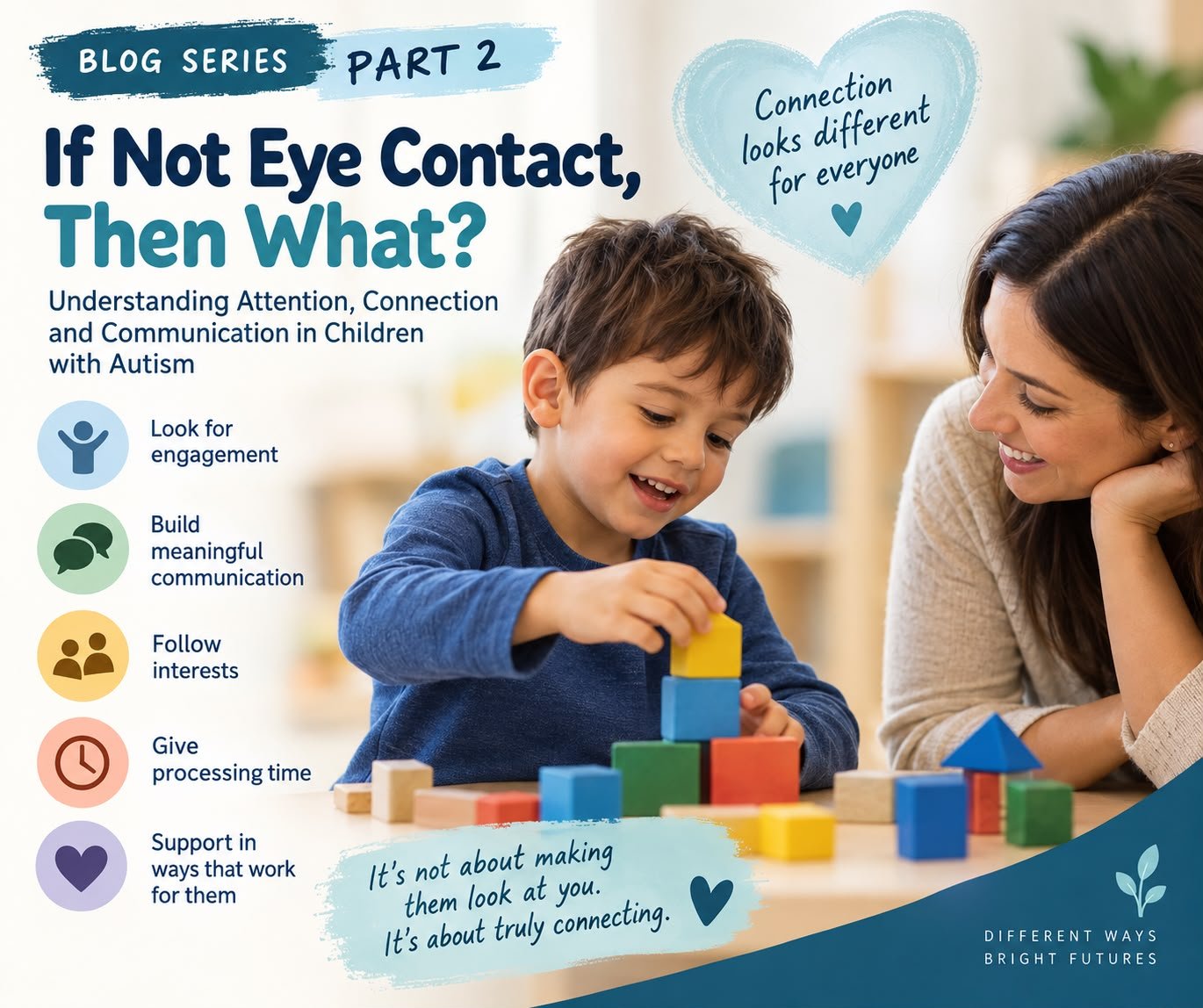
Understanding Attention, Connection and Communication in Children with Autism
In Part 1, we explored an important question:
Does looking at someone’s eyes really mean that a child is listening?
For some children with autism, the answer is no.
Eye contact can sometimes be uncomfortable, distracting or overwhelming. A child may actually listen and process information more effectively when they are looking away.
So, if eye contact isn’t the goal, what should we look for instead?
⸻
Look for engagement, not eye contact
Rather than asking, “Is the child looking at me?”, ask:
“Is the child engaged with what I am communicating?”
Engagement may look like:
* Turning towards you
* Pausing an activity
* Responding to your words
* Following an instruction
* Pointing or gesturing
* Using words or AAC
* Taking a turn
* Sharing an interest
* Demonstrating understanding through actions
A child may also look away while processing what you have said.
The eyes are only one part of the picture.
⸻
Eye Contact vs. Joint Attention
These are not the same thing.
Eye contact means looking at another person’s eyes.
Joint attention means sharing attention with another person around an object, activity or experience.
Imagine a child sees a bird outside. They notice it and point towards it, wanting their parent or teacher to notice it too.
The important message is:
“I noticed something, and I want to share it with you.”
That is meaningful social connection—even without prolonged eye contact.
⸻
Follow the child’s interests
Connection often begins by entering the child’s world.
If a child loves cars, join their play.
Roll the car. Copy their actions. Take turns. Talk about what they are doing. Pause and allow them opportunities to communicate.
Rather than interrupting their engagement to say “Look at me,” use their interest as a bridge to interaction.
Shared experiences create opportunities for communication.
⸻
Create reasons to communicate
Instead of constantly testing a child with questions such as:
“What is this?”
“What colour is this?”
“Say red.”
look for natural opportunities to communicate.
Place a favourite toy just out of reach and wait.
The child might point, reach, gesture, vocalise, use a word or AAC—or find another way to show you what they want.
When we respond to these attempts, we teach the child that communication has power and purpose.
⸻
Give processing time
Some children with autism may need additional time to process language.
Try:
Say → Pause → Wait → Observe
Instead of repeating an instruction several times, give the child a moment to understand and respond.
What looks like “not responding” may simply be “still processing.”
Sometimes, the most helpful thing we can give a child is time.
⸻
Movement does not automatically mean lack of attention
In a classroom, a child may fidget, rock, move their hands, doodle or change position while still listening and learning.
For some children, movement supports regulation and participation.
Before saying:
“Stop moving and look at me,”
ask:
“Is the movement actually interfering with learning?”
If the child is participating and understanding, the movement may not need to be stopped.
Our goal should be meaningful participation, not simply sitting still.
⸻
Let’s change the words we use
Small changes in our language can change the interaction.
Instead of saying…
Try saying…
❌ “Look at me.”
✅ “Listen, I have something important to tell you.”
❌ “Look at me when I’m talking.”
✅ “I’m going to give you an important instruction.”
❌ “Look at me before you answer.”
✅ “Take your time. I’m listening.”
❌ “You’re not listening.”
✅ “Do you need a quieter space?”
❌ “Stop looking away.”
✅ “Take your time to process.”
The shift is from demanding a behaviour to supporting communication.
⸻
What can teachers look for?
Instead of using eye contact as a measure of attention, observe whether the child can:
* Follow instructions
* Demonstrate understanding
* Participate in activities
* Respond appropriately
* Take turns
* Communicate needs
* Share interests
* Respond to others
* Complete tasks
These are more meaningful indicators of learning and engagement.
⸻
What can parents do?
Become curious about your child’s individual communication style.
Ask:
“How does my child show me they are listening?”
“How do they show me they understand?”
“What helps them feel comfortable and regulated?”
“What makes communication easier or harder?”
When we observe before correcting, we often discover that our children are communicating more than we realised.
⸻
We can still teach social communication
Not making eye contact a requirement does not mean giving up on social development.
Children with autism can be supported in developing:
* Turn-taking
* Joint attention
* Sharing experiences
* Gestures
* Functional communication
* Conversation skills
* Understanding social cues
* Expressing needs
* Asking for help
The difference is that we teach these skills while respecting the child’s sensory and communication needs.
**The goal is not to make the child look more typical.
The goal is to help the child communicate, participate and connect.**
⸻
A simple shift in perspective
Instead of asking:
“Why won’t this child look at me?”
ask:
“What helps this child connect with me?”
Instead of:
“Why isn’t the child sitting still?”
ask:
“What helps this child regulate and participate?”
And instead of:
“Is this child paying attention?”
ask:
“How is this child showing me that they are engaged?”
These questions can change the way we see—and support—children with autism.
⸻
The child doesn’t have to look at you to connect with you
The next time a child looks away while you are speaking, pause before saying:
“Look at me.”
Speak clearly.
Give them time.
Reduce unnecessary distractions.
Observe their response.
Respect their way of engaging.
Don’t wait for eye contact before offering connection.
Because attention, understanding and connection can be present—even when the eyes are looking somewhere else.
Look beyond the eyes.
Listen beyond the words.
And make room for every way a child communicates.
Minaz Ajani has a Master’s in Sp. Ed with a focus on Learning Disabilities. She is an Internationally Licensed Brain Gym®️ , Touch for Health®️ , Movement-Based Learning™️ and RMTI ®️ Instructor and consultant and founder of Manifest Your Potential (http://manifesturpotential.com)