

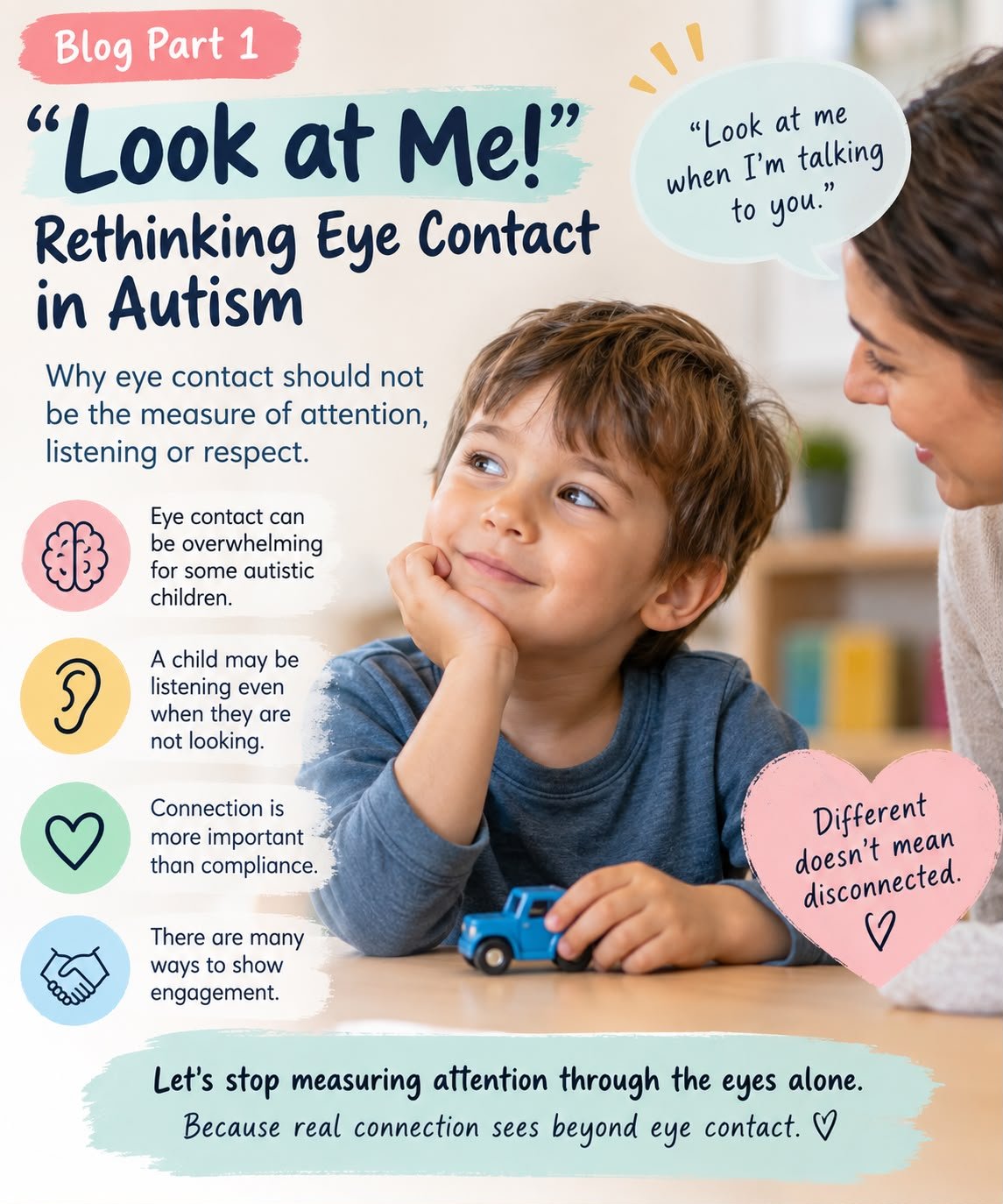
“Look at me when I’m talking to you.”
“Look into my eyes.”
“If you’re listening, look at me.”
Many parents and teachers use these phrases every day.
And they usually come from a good place.
We want children to pay attention. We want them to listen. We want to teach them social skills.
But when we are speaking to an autistic child, perhaps we need to stop and ask:
Does looking at my eyes really mean that the child is listening?
Not necessarily.
For some autistic children, direct eye contact can be uncomfortable, distracting or overwhelming.
And sometimes, asking a child to look at us can actually make it harder for them to listen and process what we are saying.
The eyes are not the only window to attention
We often assume:
Eyes looking at me = listening
and
Eyes looking away = not listening.
But attention doesn’t always look the same.
An autistic child may look away while listening carefully.
They may watch an object, move their hands, rock gently, or look towards the side while their brain processes the information.
Their eyes may be somewhere else… but their attention may still be with you.
Why might eye contact be difficult?
Autistic children can experience differences in sensory processing and regulation.
For some children, looking directly at someone’s face means taking in a huge amount of information at once:
* The person’s eyes
* Facial expressions
* Body movements
* Voice and tone
* Background sounds
* Visual distractions
* Their own sensory experiences
* The meaning of the conversation
That can be a lot to process.
Looking away may actually be a strategy that helps the child reduce visual input so they can concentrate on what you are saying.
So when we insist:
“Look at me!”
we may unintentionally be increasing the child’s load rather than improving their attention.
Eye contact is not the same as communication
We need to be careful about teaching children that eye contact is a requirement for being considered polite, attentive or socially acceptable.
A child can communicate without sustained eye contact.
They can listen without sustained eye contact.
They can connect without sustained eye contact.
And they can certainly learn without constantly looking at the teacher.
Eye contact is one form of social communication — it is not the definition of social communication.
What happens when we repeatedly force eye contact?
A child may learn to focus on performing the expected behaviour rather than understanding the message.
They may become anxious.
They may become less regulated.
They may spend so much effort trying to maintain eye contact that there is less capacity available for listening and learning.
And perhaps most importantly, they may learn:
“What I am comfortable with doesn’t matter.”
That is not the lesson we want to teach.
So should we never encourage eye contact?
Not at all.
If a child naturally enjoys looking at faces and making eye contact, wonderful.
If a child wants to develop more comfortable social interaction, we can absolutely support that.
But there is an important difference between:
encouraging a skill
and
demanding a behaviour as proof of attention or respect.
Our goal should be to develop comfortable, meaningful communication, not simply make a child look “typical.”
A different question
Instead of asking:
“Why won’t this child look at me?”
let’s ask:
“How does this child show me that they are listening?”
That question opens the door to understanding.
Perhaps the child responds to your words.
Perhaps they follow your instruction.
Perhaps they turn their body towards you.
Perhaps they answer using speech, gestures or AAC.
Perhaps they need to look away while processing.
Perhaps they need movement to stay regulated.
There are many ways a child can show us that they are connected.
Let’s stop measuring attention through the eyes alone.
Because the goal isn’t simply:
“Look at me.”
The goal is:
“Connect with me. Communicate with me. Let us understand each other.”
And that can happen—even when our eyes don’t meet.
Minaz Ajani has a Master’s in Sp. Ed with a focus on Learning Disabilities. She is an Internationally Licensed Brain Gym®️ , Touch for Health®️ , Movement-Based Learning™️ and RMTI ®️ Instructor and consultant and founder of Manifest Your Potential (http://manifesturpotential.com)