
“Every step we take begins with information our brain receives through our senses. Vision doesn’t just help us see—it helps us move.”
When we think about walking, we usually think about our legs, feet, muscles, and joints. Rarely do we consider one of the most important contributors to a smooth, confident gait—our visual system.
Walking is far more than putting one foot in front of the other. It is a beautifully coordinated process involving the eyes, brain, balance system, muscles, and nervous system working together every second.
This relationship between vision and movement is often referred to as visual gait—the way our visual system influences how we walk, maintain balance, and navigate the world around us.
Vision Is Our GPS
Imagine walking through an unfamiliar park.
Without thinking, your eyes are constantly gathering information.
* Where is the path?
* Is there a step ahead?
* Is the ground uneven?
* How far away is the next obstacle?
* Which direction should I turn?
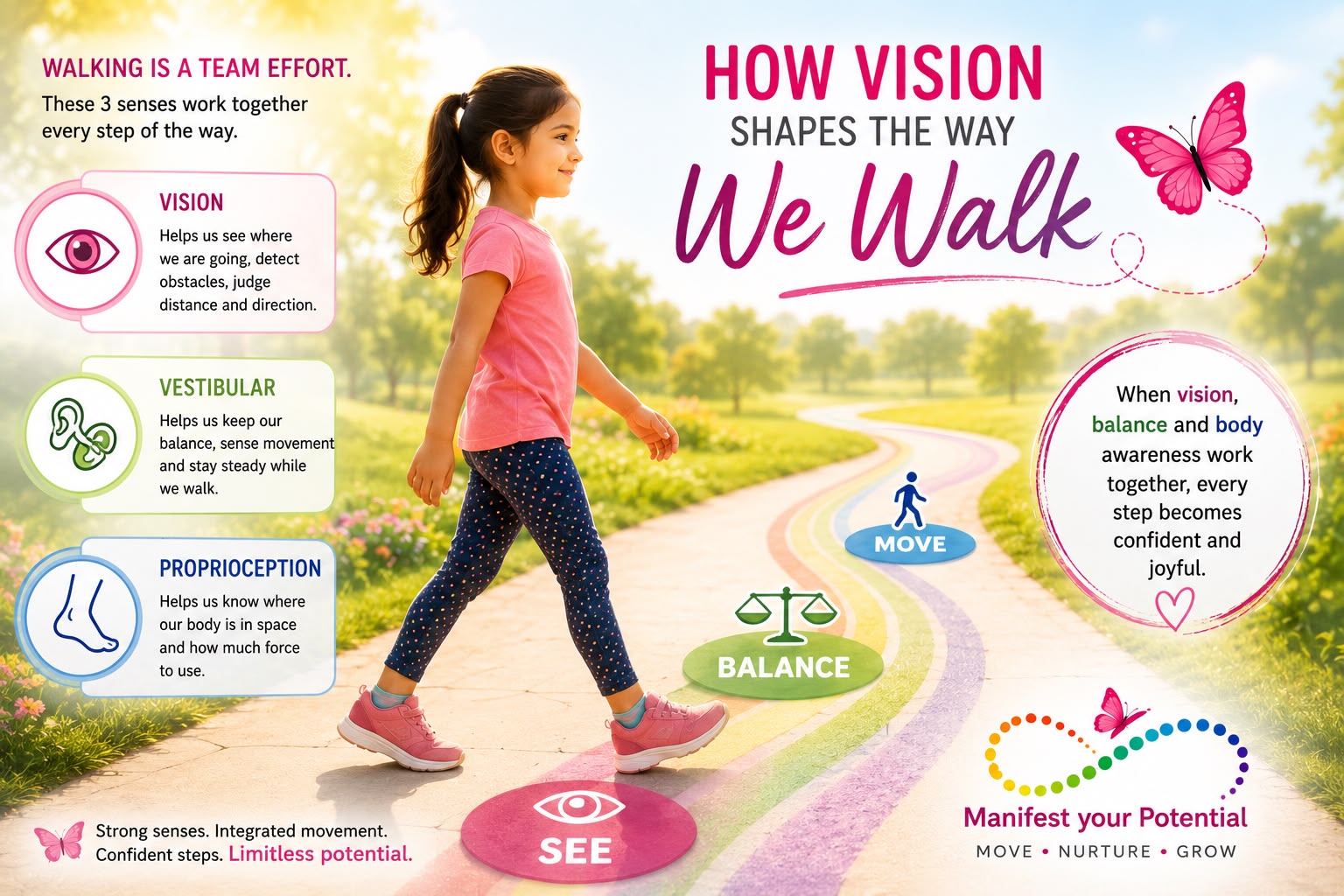
Your brain combines this visual information with signals from your balance organs (vestibular system) and your muscles and joints (proprioception). Together, these systems create smooth, coordinated movement.
Vision acts like a GPS, continuously guiding every step.
What Happens When Vision Isn’t Working Efficiently?
Even if someone has 20/20 eyesight, their brain may not be processing visual information efficiently.
As a result, they may:
* Walk more slowly.
* Frequently look down while walking.
* Hesitate before stepping onto stairs.
* Trip over objects.
* Lose balance on uneven ground.
* Avoid crowded places.
* Feel dizzy or disoriented in busy visual environments.
Sometimes these individuals are described as clumsy, uncoordinated, or lacking confidence.
Often, their nervous system is simply working much harder to process the information needed for safe movement.
Vision Is Only One Piece of the Puzzle
Walking depends on three major sensory systems working together.
👁️ Vision
Provides information about the environment, obstacles, distance, movement, and direction.
⚖️ Vestibular System
Located in the inner ear, it tells us whether we are moving, turning, speeding up, or slowing down. It helps maintain balance and stabilizes our gaze while walking.
💪 Proprioception
Provides feedback from our muscles and joints, letting the brain know where each body part is without looking.
When these three systems communicate efficiently, movement becomes automatic.
The Role of Primitive Reflexes
In our work with children and adults, we often see that retained primitive reflexes can influence gait.
For example:
* Poor postural control
* Difficulty crossing the midline
* Toe walking
* Reduced balance
* Uneven weight shifting
* Hesitant movement
* Poor coordination
Primitive reflex integration may help improve the foundation upon which balance and movement develop.
Why Some Children Keep Looking at Their Feet
Many parents notice their child constantly watching their feet while walking.
This may happen because the brain is relying heavily on vision instead of trusting information coming from the vestibular and proprioceptive systems.
As these sensory systems become better integrated, children often become more confident moving through their environment without needing to constantly monitor every step.
Supporting Healthy Visual Gait
The good news is that the nervous system is adaptable.
Simple daily activities can strengthen the connection between vision, balance, and movement.
These include:
* Walking outdoors on different surfaces.
* Balance games.
* Catching and throwing balls.
* Looking near and far while walking.
* Walking on lines or balance beams.
* Crawling and cross-lateral movements.
* Nature walks.
* Obstacle courses.
* Activities that encourage peripheral awareness.
These playful experiences help the brain become more efficient at integrating sensory information.
A Whole-Body Perspective
At Manifest Your Potential, we believe movement begins long before the first step.
It begins with how the brain interprets information from the eyes, ears, muscles, and body.
When vision, balance, and proprioception work together, walking becomes more than movement—it becomes confidence, exploration, independence, and learning.
Every confident step is built on a well-integrated nervous system.
Sometimes, improving the way we move starts by improving the way we see.
⸻
Key Takeaway
Visual gait is not just about walking. It is about how vision guides balance, posture, confidence, and movement through the world. When the visual, vestibular, and proprioceptive systems work together, every step becomes more stable, efficient, and joyful.
Minaz Ajani has a Master’s in Sp. Ed with a focus on Learning Disabilities. She is an Internationally Licensed Brain Gym®️ , Touch for Health®️ , Movement-Based Learning™️ and RMTI ®️ Instructor and consultant and founder of Manifest Your Potential (http://manifesturpotential.com)