

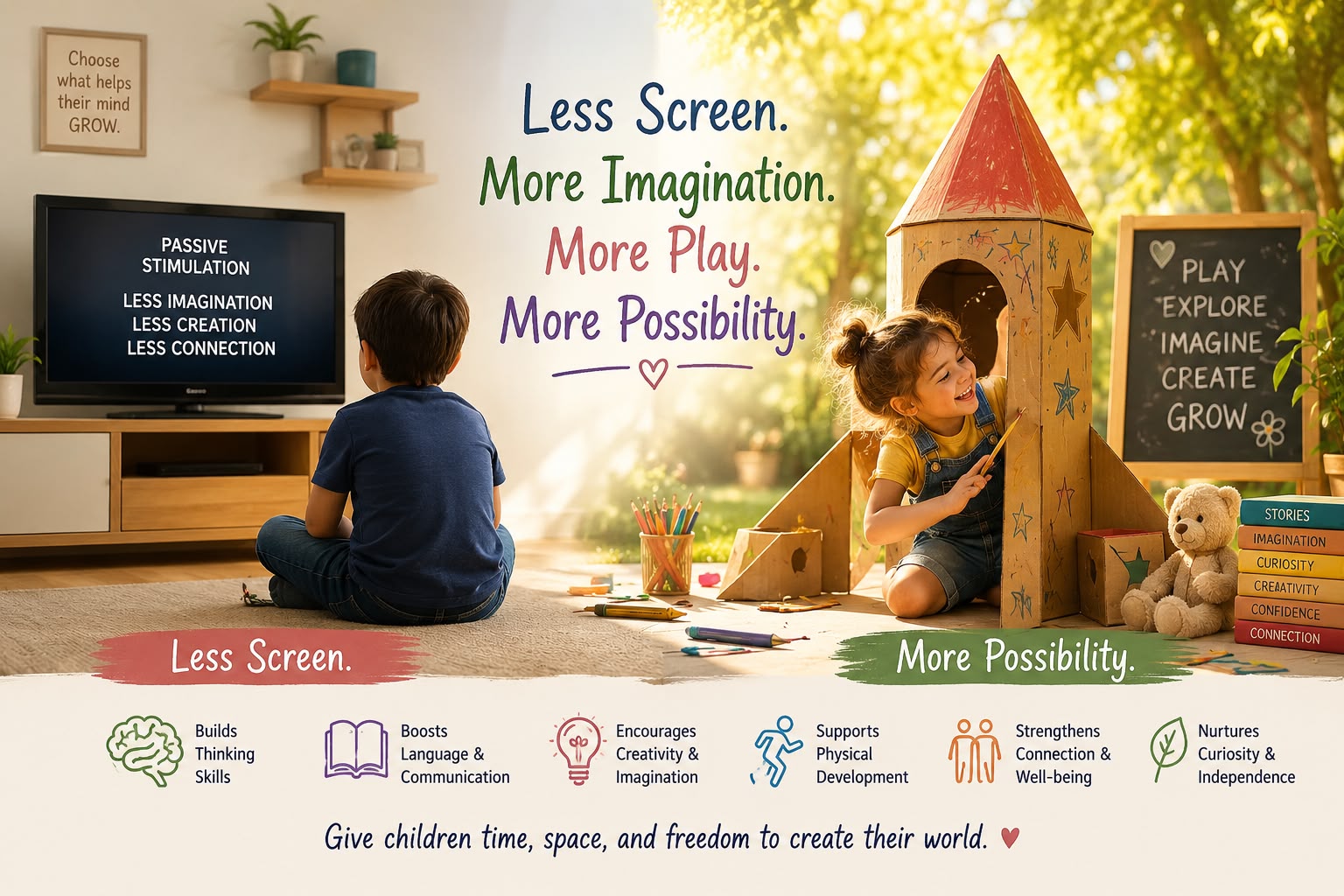
In today’s world, screens are everywhere. Television, computers, tablets, smartphones, and automated toys have become a regular part of childhood. While technology certainly has its place, an important question remains:
What is happening to a child’s developing brain, imagination, and thinking when screens become their primary source of entertainment?
Richard S. Kavner, in Your Child’s Vision, reminds us that:
“Television trains people not to react. It is a potent source of stimulation for the unconscious. Dreams and fantasies are aroused, but conscious thinking is depressed.”
This statement invites us to pause and reflect. Television presents images, sounds, emotions, and stories that require very little active participation. The brain receives a constant stream of information, but it does not have to imagine, question, solve problems, or create. The child becomes a passive observer rather than an active participant.
Passive Entertainment vs. Active Learning
Children learn best when they move, explore, build, imagine, ask questions, and interact with the real world.
When much of their free time is spent watching screens or playing with highly automated toys, they lose valuable opportunities to:
* Invent their own games.
* Create imaginary worlds.
* Solve problems independently.
* Develop language through conversation.
* Strengthen attention and observation skills.
* Engage all of their senses.
Dr. Carla Hannaford, in Why Learning Is Not All in Your Head, beautifully explains that television, computers, and automated toys often occupy the very time children would otherwise spend creating and exploring.
She writes that if children are given space and encouragement to create, they naturally entertain themselves without sophisticated equipment or constant adult intervention.
Creativity does not always come from expensive toys or structured activities.
Often, it grows from boredom.
When children are allowed to experience quiet moments without immediate stimulation, their imagination begins to work. A stick becomes a magic wand. A cardboard box becomes a spaceship. A blanket becomes a castle.
These simple experiences build flexible thinking, creativity, and resilience.
Why Early Childhood Matters
Dr. Hannaford also supports the views of Joseph Chilton Pearce and Jane Healy, who suggest that television should be avoided before the age of eight.
Their concern is not about entertainment itself—it is about protecting the years when the foundations of imagination, language, and thinking are still developing.
Before these abilities are firmly established, excessive screen exposure may replace opportunities for:
* storytelling,
* pretend play,
* meaningful conversations,
* movement,
* reading,
* and creative exploration.
These experiences are the building blocks of learning.
What Can Parents Do Instead?
You don’t need elaborate activities to nurture a child’s brain.
Sometimes the greatest gift is simply providing time and space.
Encourage children to:
* Play outdoors.
* Read books together.
* Build with blocks or recycled materials.
* Draw, paint, and create.
* Listen to music.
* Tell stories.
* Explore nature.
* Dance, climb, jump, and move.
* Wonder, imagine, and ask questions.
These everyday experiences nourish the developing brain far more deeply than passive screen viewing.
A Balanced Perspective
Technology is a part of modern life and can certainly be used thoughtfully. The goal is not to fear screens but to ensure they do not replace the experiences that children’s developing brains need most.
The richest learning happens when children actively engage with people, movement, nature, and their own imagination.
When we protect time for curiosity, creativity, conversation, and play, we are nurturing skills that no screen can fully replace.
As adults, perhaps our greatest responsibility is not simply to entertain children—but to give them the freedom to imagine, create, and discover who they are.