

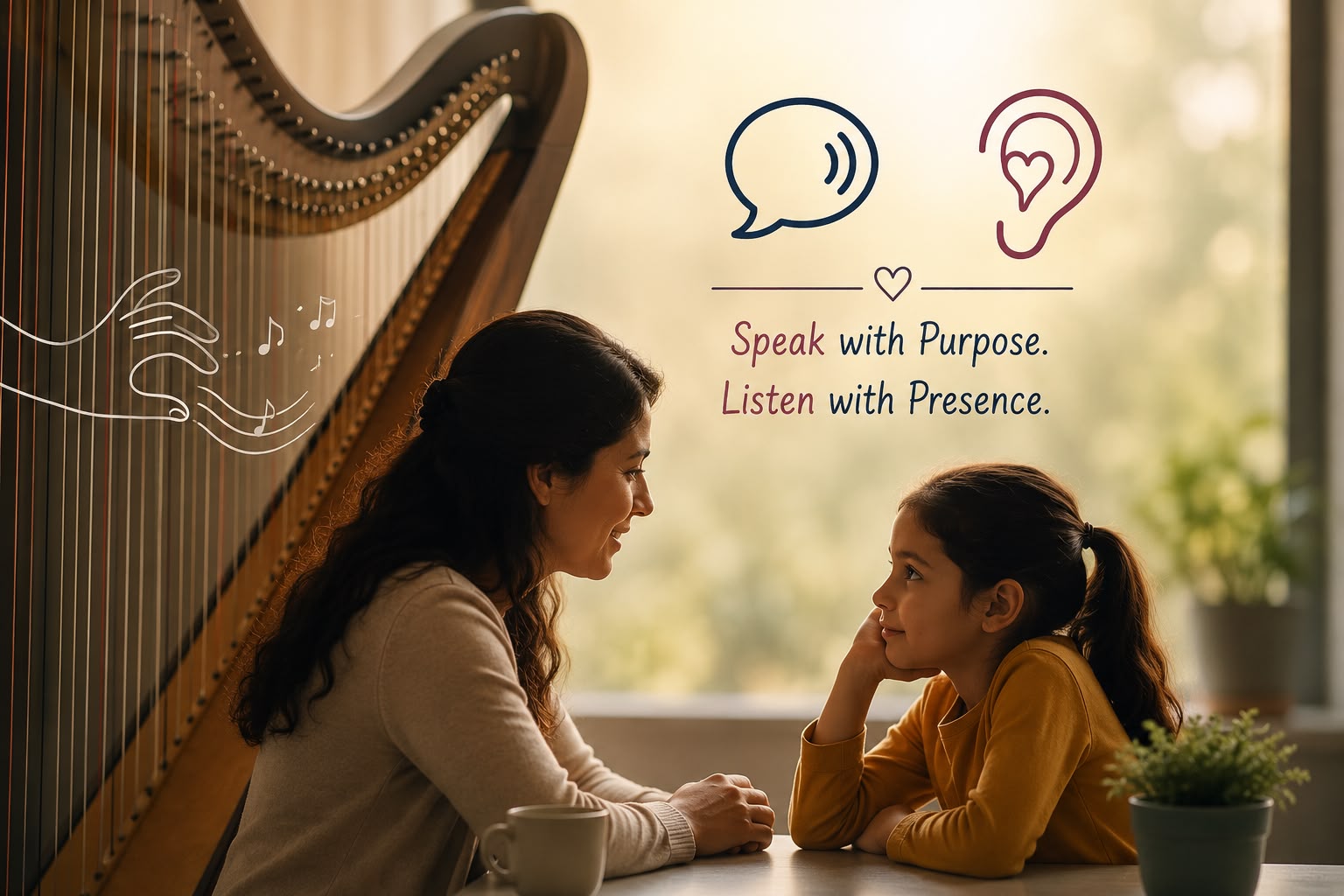
“Talking is like playing on the harp; there is as much in laying the hand on the strings to stop their vibrations as in twanging them to bring out their music.”
— Oliver Wendell Holmes Sr., The Autocrat at the Breakfast Table (1858)
Communication is often thought of as speaking well—choosing the right words, expressing our thoughts clearly, or sharing our opinions confidently.
But Oliver Wendell Holmes Sr. reminds us that communication is much more than speaking. Like a harpist creating beautiful music, an effective communicator knows not only when to play the strings but also when to gently still them.
Silence, listening, and thoughtful pauses are just as important as words.
The Space Between the Notes
Beautiful music is not created by sound alone. It is the pauses between the notes that give music its rhythm, emotion, and meaning.
Human communication works in much the same way.
When we rush to respond, interrupt, or fill every silence, we may miss what another person is truly trying to say.
Sometimes the most powerful communication happens in the quiet moments:
* A parent patiently listening to a child.
* A teacher waiting for a student to find the right words.
* A friend sitting silently beside someone who is grieving.
* A therapist allowing space for reflection instead of offering immediate advice.
These moments communicate, “I am here. I am listening. You matter.”
Listening Is an Active Skill
Many people hear words, but few truly listen.
Listening means paying attention not only to what is spoken but also to:
* facial expressions,
* tone of voice,
* body language,
* emotions,
* and even what remains unsaid.
Children, especially, communicate through behaviour long before they can express themselves with words. A child who is restless, withdrawn, or angry may be telling us something that language cannot yet express.
Listening helps us understand the message behind the behaviour.
The Courage to Pause
In today’s fast-paced world, we often feel pressured to respond immediately.
Yet thoughtful pauses allow us to:
* regulate our emotions,
* choose kinder words,
* avoid misunderstandings,
* and respond rather than react.
A brief moment of silence can prevent an argument, strengthen a relationship, or create space for someone else to feel heard.
Sometimes, the kindest response is not an immediate answer but a calm, attentive presence.
Communication Is a Two-Way Dance
Healthy communication is not about winning conversations or proving a point.
It is about creating connection.
This requires a balance of:
* speaking with honesty,
* listening with empathy,
* observing without judgment,
* and responding with intention.
When both people feel heard, trust begins to grow.
Helping Children Learn the Music of Communication
Children learn communication not only from what we say but from how we interact with them.
We can nurture healthy communication by:
* giving children uninterrupted time to speak,
* listening without immediately correcting or solving,
* encouraging them to express their feelings,
* modelling respectful disagreement,
* and showing that silence is comfortable, not awkward.
These experiences teach children that communication is about understanding—not simply talking.
A Final Reflection
A skilled musician knows that every note does not need to be played.
A skilled communicator knows that every thought does not need to be spoken immediately.
Sometimes our words inspire.
Sometimes our silence comforts.
Sometimes our listening heals.
Perhaps the greatest gift we can offer another person is not the perfect response, but our full attention.
Because true communication is not measured by how much we speak.
It is measured by how deeply we connect.
Minaz Ajani has a Master’s in Sp. Ed with a focus on Learning Disabilities. She is an Internationally Licensed Brain Gym®️ , Touch for Health®️ , Movement-Based Learning™️ and RMTI ®️ Instructor and consultant and founder of Manifest Your Potential (http://manifesturpotential.com)